Showing posts with label Catholic Church. Show all posts
Sunday, May 10, 2015
Wednesday, January 22, 2014
Pro-Life Monaco
It is simply a fact that most do not immediately think of the Principality of Monaco as a very "religious" country. However, if you look past the glitz and glamour, the gaming tables and luxury yachts, it remains an officially Catholic country and one of the last officially Catholic monarchies in the world. Today, in the United States, pro-life advocates are holding their annual pro-life march in Washington DC, marking the day when abortion became legal. Those who believe in the right to life will be happy to know that, despite some unfortunate changes, Monaco remains a strongly pro-life country. For most of Monegasque history, of course, this was taken for granted. However, in became explicit thanks to HSH Prince Rainier III who suspended the constitution in 1959 in order to re-work things. When the new constitution was enacted in 1962 the Prince saw to it that it made abortion absolutely illegal in Monaco for any reason. Obviously, being surrounded by France (rarely more than a short walk away) anyone wanting an abortion could easily obtain one, but this was a matter of principle for the staunchly Catholic Prince who believed in the right to life. The "unfortunate" part came in 2009 when this law was amended to allow for abortion in extreme cases such rape, fetal illness/deformity or if the life of the mother is imperiled. I would not be surprised if that was not done with some EU pressure, but that is just my opinion. In any event, even with that amendment, Monaco still remains one of the most pro-life countries in Europe (or the world for that matter) and HSH Prince Albert II has also given his support to the study of adult stem cells for medical research, encouraging this in a way that does not require the destruction of human embryos. A very noble activity.
Friday, May 24, 2013
Ancestral History and a Pilgrimage
Recently, HSH Prince Albert II was in France visiting one of the former estates of the Grimaldi; the former Duchy of Valentinois (Duke of Valentinois still being one of the titles of the prince). In Chabeuil the Sovereign Prince visited the old Hotel des Princes and opened the Place "Marie-Pelline Grimaldi of Monaco, maid of Chabeuil". Marie-Pelline was the daughter of Prince Antoine I of Monaco and gained lasting fame thanks to the harpsichord piece written for her by Francois Couperin. Prince Albert II visited some other historic villages and landmarks in the area, met with local officials and even took the "Promenade des Princes de Monaco" in Buis-les-Baronnies as well as attending the medieval festival in Crest (bet that was fun). The Duchy of Valentinois was ceded to the House of Grimaldi a year after the Treaty of Peronne in 1641 between King Louis XIII of France and Prince Honore II of Monaco which ended the Spanish protectorate over Monaco and by which the Kingdom of France recognized and guaranteed the independence of the Principality. Although the title is still retained, the actual Duchy of Valentinois was lost to the Prince of Monaco during the French Revolution and the abolition of the Bourbon monarchy.
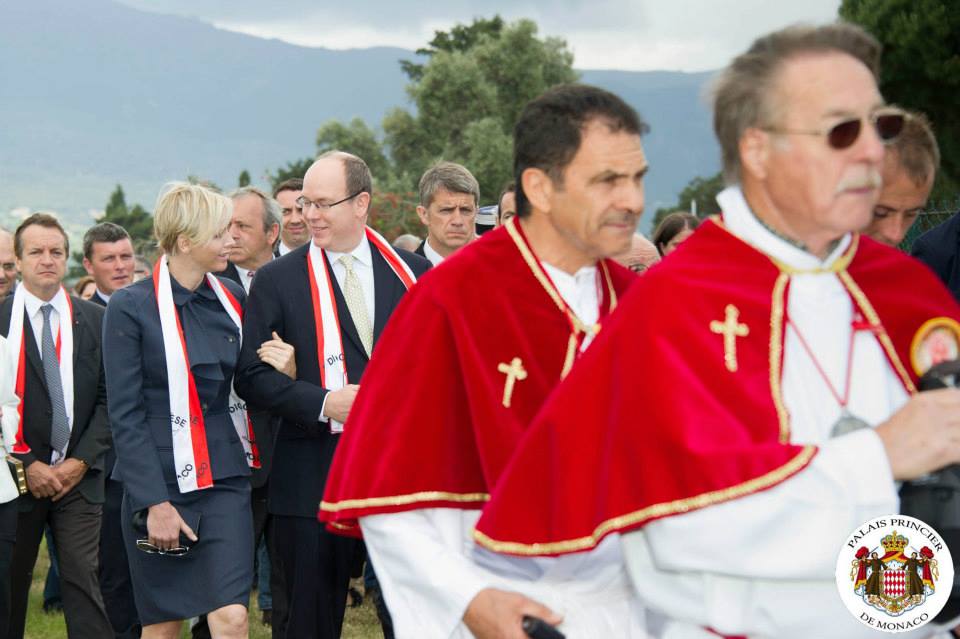
On Tuesday TSH Prince Albert II and Princess Charlene visited the French island of Corsica on a pilgrimage to Bastia honoring St Devote, the patron saint of Monaco and the House of Grimaldi. St Devote is also patron saint of Corsica and Monegasque survival of a French-Corsican attack on the tiny country is attributed to the miraculous intervention of St Devote who is said to have appeared over the Monegasque battlements to reprimand the attackers, particularly the Corsicans who so revere her.
Thursday, May 9, 2013
Bishop Louis-André de Grimaldi
Wikipedia (which must always be taken with at least a cup of salt) gave front page coverage to an article on Louis Andre de Grimaldi, member of the French aristocracy and a bishop of the Catholic Church who, in a number of ways, embodied both the good and the bad of the French clergy at the time of the outbreak of the French Revolution. He was actually the man who ordained Talleyrand (would that be considered a good thing or a bad thing these days?) but I will always give him some credit at least for refusing the oath.
Tuesday, March 19, 2013
Princely Couple at Papal Inauguration
The Princely couple at prayer. These are the best photos
Prince Albert II and Princess Charlene give polite praise as Pope Francis passes
The Princely couple were seated next to another Albert II, the King and Queen of the Belgians. Queen Paola couldn't resist snapping a photo on her smart phone as the Pontiff went by.
Pope Francis greets the applause of the congregation
HSH Princess Charlene taking communion. King Albert II seems very interested but Queen Paola seems a little bored.
Thursday, February 14, 2013
Prince Reacts to Papal Resignation
HSH Prince Albert II of Monaco has been visiting Brazil lately and was there when he learned, along with the rest of the world, that His Holiness Pope Benedict XVI will resign from his office at the end of the month. Monaco has a long and close history with the papacy and the Principality is one of the last remaining officially Catholic monarchies in the world. Prince Albert II, who attended the inauguration of Pope Benedict XVI, was quick to release a statement saying that he was emotional upon hearing the news that the Pope would be stepping down but called the decision "courageous". The Sovereign Prince praised the Pope and spoke of his most recent visit to the Vatican with HSH Princess Charlene, which was the first time the Princess had met the Pontiff. Prince Albert also assured the Pope that he would remain in the prayers of the House of Grimaldi. Pope Benedict XVI cited his age and physical weakness as the reason for his resignation. The Pope had planned to visit the Principality of Monaco last year but it never came about, possibly due to the Pontiff's increasing frailty. The Principality of Monaco has maintained diplomatic relations with the Holy See longer than almost any other existing country and Prince Albert II is a high ranking member of the Knights of Malta and a Knight Grand Cross of the Order of the Holy Sepulchre.
Saturday, January 12, 2013
The Pontiff and the Princely Couple
HSH Princess Charlene (Catholic convert) looking pretty and proper in a veil
His Holiness Pope Benedict XVI welcomed TSH Prince Albert II and Princess Charlene to the Vatican for a private audience at the Apostolic Palace. I believe this was the first time Princess Charlene has met the Pontiff and it was an occasion to renew and highlight the very long history of close relations between the Principality of Monaco and the Holy See.
Monday, May 14, 2012
Princely Pilgrimage to Lourdes
This weekend the "International Military Pilgrimage Mass" was held at the International Basilica of St Pius X (also known as the Underground Basilica) at Lourdes, France and this year there were two special guests that turned many heads, Their Serene Highnesses Prince Albert II and Princess Charlene of Monaco. The Princely couple came with the Monegasque delegation, not on an official visit or part of a private tour, but simply as two more pilgrims. The Sovereign Prince did not speak at the event but did meet with Bishop Luke Ravel of the armed services and Bishop Brouwet of Tarbes-Lourdes. Before the international mass the Prince and Princess did arrange a private tour of the grotto. The site of the vision of Our Lady of Lourdes holds a special distinction for the Princely Family of Monaco and this was not Prince Albert's first visit, nor will it be his last. Prince Albert II came to Lourdes in 2008 after the visit of His Holiness Pope Benedict XVI and hopes to return again this summer with the regular pilgrimage of Monegasque faithful. His father, Prince Rainier III had gone on a pilgrimage to Lourdes to pray that Our Lady would help him find a good wife. Not long after he met and was soon married to Princess Grace who, at her confirmation, had taken as her patron St Bernadette, the little visionary of Lourdes so, it seemed, the hand of the Holy Mother had brought the two together and Lourdes has remained important to the House of Grimaldi ever since.
Saturday, May 12, 2012
The Month of Mary
With all of the glitz and glamour it can be easy to forget that the Principality of Monaco is one of the few remaining officially Catholic monarchies in the world, but, so it is and May is the month of the Blessed Virgin Mary. Of course the Archdiocese of Monaco observes all the proper Marian holidays along with the special feasts of St Devote and St Rainier and others special to Monaco and the House of Grimaldi. One of the ways the Principality has recognized religious figures, including the Holy Mother, is by issuing special stamps. In the past quite a few stamps were issued with religious themes or honoring religious occasions. One such example, featuring the Blessed Virgin Mary, was this one from 1958 marking the 100th anniversary of the proclamation of the Immaculate Conception. It features the Roman Pontiffs Pius XII and Blessed Pius IX flanking the image of Our Lady of the Immaculate Conception.
Friday, April 6, 2012
Friday, December 2, 2011
Remembering Pope John Paul I
I was recently remembering the all too short-lived Pope John Paul I, of whom Prince Rainier III and Princess Grace were quite fond. Here is a photographic look back:
Pope John Paul I meets Princess Grace and Prince Rainier III shortly after his election.
The effects of the "Smiling Pope" are evident on the faces of those who saw him.
Sadly, the next trip to the Vatican by the Princely Couple would be for the Pontiff's funeral.
Their sorrow was clearly evident.
Sunday, November 20, 2011
Solemnity of Christ the King
Today is the Solemnity of Christ the King in the Roman Catholic Church, official religion of Monaco, and a day when we are all reminded that even God is a monarchist. Have a good one. -MM
Sunday, October 16, 2011
Monaco and the Papacy
Recently “Rome Reports” (a good place to get news about the Pope and news concerning the Holy See) stated that HSH Prince Albert II had visited the Pope once but that he was planning to visit the Vatican again to introduce his wife Princess Charlene (a Catholic convert) to the Pontiff. I’m not sure where they came up with Prince Albert only visiting the Pope once unless that is to say he has only made one formal visit, as Sovereign Prince, to the Pope following his enthronement. Prince Albert has visited the Vatican many times, prior to his succession, he met Pope John Paul II on more than one occasion and the Prince was present at the enthronement of HH Pope Benedict XVI. It has also been said that the Supreme Pontiff will make a historic visit to Monaco sometime next year. However, this provides an opportunity to talk about the long and close ties between the Holy See and the Principality of Monaco. The diplomatic ties between Monaco and the Holy See are some of the oldest in Catholic history.
As we know, the Grimaldi family first left Genoa and came to Monaco as a result of the Guelf-Ghibelline feud that once raged across northern Italy. Eventually, this became simply a feud but the original reason for it was a clash between the Pope on one side and the Holy Roman Emperor (basically the ruler of Germany) on the other. The Guelf faction (to which the Grimaldis adhered) supported the Pope while the Ghibellines supported the Emperor. So, the House of Grimaldi has been on the side of the Pope from the very beginning of the history of Monaco. From the very beginning the official state religion of Monaco has been the Christian religion as taught by the Roman Catholic Church. One of the most significant figures in the history of Monaco was a Catholic bishop, Bishop Agustin Grimaldi, regent for Lord Honore I. It was Lord Honore I who welcomed Pope Paul III to Monaco, the first time a Pontiff ever visited the country. Numerous members of the Grimaldi family joined the Church, such as HSH Princess Charlotte, daughter of HSH Prince Jacques I of Monaco, joined the Order of the Visitation as a nun.
Even members of the Grimaldi House one might not ordinarily consider the “religious types” have supported the Church such as Princess Catherine-Charlotte founded the Convent of the Visitation in Monaco. There were, of course, occasions in history when there were tensions such as when Prince Charles III expelled the Jesuits for their opposition to his establishment of the Monte Carlo Casino. However, hard feelings never lasted long. After the fall of the Papal States and the formation of the Kingdom of Italy, the Principality of Monaco was a haven for many of the veterans of the former papal army who were sheltered in Monaco and paid as their own unique military unit, a sort of Catholic addition to the Princely Rifles. There is even a street named after them in Monaco. The Princes of Monaco have a long history of generous support for the Church, even though there were occasional bumps in the road, usually due to the rocky record of marriage in the Grimaldi family, but Church law has always been respected.
Most recently, Prince Albert II has had to walk a rather fine line between the Catholic tradition of Monaco and the secularism that dominates modern western Europe. One area that has caused some friction is abortion. Prince Rainier III was adamant in completely banning the practice in Monaco but Prince Albert, as part of standards required by the European community, did not stop a law going through allowing for abortion in cases of rape, fetal illness or deformity or if the life of the mother is imperiled. However, as those are the only exceptions, Monaco is still regarded as one of the few western European countries where abortion is illegal. In 2009 Prince Albert II served as patron of a conference organized by the Pontifical Academy for Life, among others, to promote adult stem-cell research which does not involve the destruction of human embryos. In 2010 the Prince signed on to a coalition of twenty Catholic and Orthodox countries to defend the Christian tradition of Europe, “against the secularism, liberalism and relativism that prevail in modern Europe”. HSH Prince Rainier III, a devout Catholic who sought the Papal blessing at every major event of his reign, was a high-ranking member of the Knights of Malta and held the Papal honors of the Order of the Golden Spur and the Order of the Seraphs. Likewise, Prince Albert II is one of the highest ranking members of the Knights of Malta and a Knight Grand Cross of the Order of the Holy Sepulchre, a Catholic order under Papal protection, of which he has been a member since 1983.
As we know, the Grimaldi family first left Genoa and came to Monaco as a result of the Guelf-Ghibelline feud that once raged across northern Italy. Eventually, this became simply a feud but the original reason for it was a clash between the Pope on one side and the Holy Roman Emperor (basically the ruler of Germany) on the other. The Guelf faction (to which the Grimaldis adhered) supported the Pope while the Ghibellines supported the Emperor. So, the House of Grimaldi has been on the side of the Pope from the very beginning of the history of Monaco. From the very beginning the official state religion of Monaco has been the Christian religion as taught by the Roman Catholic Church. One of the most significant figures in the history of Monaco was a Catholic bishop, Bishop Agustin Grimaldi, regent for Lord Honore I. It was Lord Honore I who welcomed Pope Paul III to Monaco, the first time a Pontiff ever visited the country. Numerous members of the Grimaldi family joined the Church, such as HSH Princess Charlotte, daughter of HSH Prince Jacques I of Monaco, joined the Order of the Visitation as a nun.
Even members of the Grimaldi House one might not ordinarily consider the “religious types” have supported the Church such as Princess Catherine-Charlotte founded the Convent of the Visitation in Monaco. There were, of course, occasions in history when there were tensions such as when Prince Charles III expelled the Jesuits for their opposition to his establishment of the Monte Carlo Casino. However, hard feelings never lasted long. After the fall of the Papal States and the formation of the Kingdom of Italy, the Principality of Monaco was a haven for many of the veterans of the former papal army who were sheltered in Monaco and paid as their own unique military unit, a sort of Catholic addition to the Princely Rifles. There is even a street named after them in Monaco. The Princes of Monaco have a long history of generous support for the Church, even though there were occasional bumps in the road, usually due to the rocky record of marriage in the Grimaldi family, but Church law has always been respected.
Most recently, Prince Albert II has had to walk a rather fine line between the Catholic tradition of Monaco and the secularism that dominates modern western Europe. One area that has caused some friction is abortion. Prince Rainier III was adamant in completely banning the practice in Monaco but Prince Albert, as part of standards required by the European community, did not stop a law going through allowing for abortion in cases of rape, fetal illness or deformity or if the life of the mother is imperiled. However, as those are the only exceptions, Monaco is still regarded as one of the few western European countries where abortion is illegal. In 2009 Prince Albert II served as patron of a conference organized by the Pontifical Academy for Life, among others, to promote adult stem-cell research which does not involve the destruction of human embryos. In 2010 the Prince signed on to a coalition of twenty Catholic and Orthodox countries to defend the Christian tradition of Europe, “against the secularism, liberalism and relativism that prevail in modern Europe”. HSH Prince Rainier III, a devout Catholic who sought the Papal blessing at every major event of his reign, was a high-ranking member of the Knights of Malta and held the Papal honors of the Order of the Golden Spur and the Order of the Seraphs. Likewise, Prince Albert II is one of the highest ranking members of the Knights of Malta and a Knight Grand Cross of the Order of the Holy Sepulchre, a Catholic order under Papal protection, of which he has been a member since 1983.
Monday, August 22, 2011
Queenship of Mary
Today the Catholic Church (the state religion of Monaco) celebrates the Feast of the Queenship of Mary. This image of the Blessed Virgin, Queen of Heaven, can be found in St Nicholas Cathedral in Monte Carlo. A nice holiday and further proof that God is a monarchist -His mother is a Queen!
Monday, April 4, 2011
Charlene Swims the Tiber
Princess-to-be Charlene Wittstock, former Olympic swimmer, has swam the Tiber! Yes, according to People magazine, after quite a period of "is she or isn't she" it was announced today that Charlene has decided to come to 'home, sweet Rome' and officially converted to the Catholic faith. Charlene was raised a Protestant and though there is no law in Monaco that would requite the princess consort to embrace a certain religion, the state religion of Monaco is Roman Catholic and the vast majority of the Monegasque population has always belonged to the Catholic Church. Prince Albert II was adamant in past interviews that the issue was totally up to Charlene and she was under no pressure, however, it would be unrealistic to think that the weight of tradition was not felt. There has never been a Princess of Monaco who was not Catholic, the ties between the House of Grimaldi and the Church are older than the country itself and the diplomatic ties between Monaco and the Holy See are older than almost any other country. In a short statement from the Princely Palace it was said, "Miss Charlene Wittstock, who professes the Christian faith, has been admitted by free and personal choice into full communion with the Catholic Church." This is very good news as the future Princess of Monaco will now be united in faith were her husband, the rest of the Grimaldi family and the people of Monaco. Congratulations to Charlene on this important occasion in her life.
Wednesday, March 2, 2011
Religious Questions & Charlene
There have been alot of rumors flying about lately regarding the religion of the next Princess of Monaco. Charlene was raised Protestant but, in an interview (which readers will have seen) she identified herself only as "Christian". The media had reported (in one of those off-hand type remarks the modern media is so good at, and frequently passes along incorrect information) that Charlene was taking catechism classes and would or had become Catholic. In the interview mentioned above, when asked about the subject of religion, Prince Albert II pointed out that, unlike Great Britain for example, there is freedom of religion for everyone in Monaco, including the spouse of the Sovereign Prince. Charlene does not have to be a Catholic to be the Princess of Monaco, though it would be the first time in the very long history of the country that such a thing happened.So, now there is speculation about whether Charlene is or is not a Catholic or if she has or does not have any plans to change her religion. Charlene has attended mass with the Grimaldis, she crossed herself, genuflected to the Archbishop and so on. I don't know if she's taken communion, that is not usually shown anyway. Few would accuse the Grimaldis of being a devoutly religious family these days, but they do take religion seriously. Princess Stephanie, known for her 'wild ways' respectfully abstains from communion when that is called for and Prince Albert II has had very good relations with the Holy See throughout his reign. Now, whether Charlene is or is not a Catholic at this time I cannot say with 100% certainty. She has shown almost all the outward signs of being one and it would be my opinion that she is or is in the process of becoming one.
To be rather blunt, I don't think Charlene gives religious issues a great deal of attention. That is no slam against her, some people make it a priority and other people do not -it's just not a part of their lives. In an interview with her parents they made no issue out of the difference in religious upbringing between their daughter and her intended. Despite the fact that there is no law against it, I would be very, very surprised if Charlene remained even a nominal Protestant. It would be unprecedented in Monegasque history and I think would reflect poorly on her, given that she has not given the impression of specific church membership being that important to her, not to go along with the religion of her husband and the vast majority of the people of Monaco. To stress though, it is my opinion that she has become a Catholic or will shortly, perhaps at Easter time (which is when it usually happens but not always). If there is a public confirmation at Easter in preparation for the marriage it will certainly be known.
Friday, January 28, 2011
Honoring Saint Devote
HSH Prince Albert II, joined by fiance Charlene Wittstock, sets fire to a boat to be cast out to sea in the traditional ceremony closing the days festivities honoring St Devote, patron of Monaco and the House of Grimaldi. This particular tradition dates back to 1924 when first performed by Prince Louis II (Albert's great-grandfather). The event commemorates the theft of the relics of St Devote with the robber trying to escape by boat only to be captured by local fishermen and brought back to shore. His boat was then burned as an offering. HRH Princess Caroline of Hanover was also present for the festivities, making it a much more 'family affair' than was the case last year.
Thursday, January 27, 2011
Charlene Celebrates St Devote
Showing again how Charlene is becoming more and more an official member of the family in the lead-up to their wedding, today Charlene joined in the official celebrations marking the feast of St Devote, patron saint of Monaco and special protector of the Princely Family. Dressing very traditionally (good to see) Charlene joined her Prince at St Nicholas Cathedral for mass. It was expected the couple would marry in this cathedral as Rainier III and Grace did but it was announced they would instead have an outdoor wedding at the palace. Armani has also said he will be designing the wedding gown. In any event, it is good to see Charlene taking part in the traditional life of Monaco and becoming more involved with Monegasque culture as she prepares to become Princess of this jewel on the Mediterranean.
Monday, December 6, 2010
Pope Paul III
One of the popes with a special place in the history of Monaco was His Holiness Pope Paul III, the first Roman Pontiff to ever visit the principality. He was also a figure who embodied both good and bad aspects of the Renaissance papacy but also a great reformer. He was born Alessandro Farnese on February 29, 1468 in what was then the Papal States. His family, the Farnese, were a very old Italian family who had gained great success over the years and aside from gaining high position in the Church also became the Dukes of Parma. His mother was from the also well-placed Caetani family which included among its members the controversial Pope Boniface VIII in the Middle Ages. Young Alessandro Farnese was given the best education money could buy, studying at the University of Pisa and at the court of Lorenzo de Medici. Throughout his life he was immersed in the glorious atmosphere of Renaissance Italy. He learned to appreciate great art, great literature, philosophy and the art of unscrupulous political advancement.
In 1491 he was given a place in the Curia and in 1493 Pope Alexander VI made him a Cardinal-Deacon. He proved impressive and Pope Clement VII later made him Cardinal Bishop of Ostia and dean of the College of Cardinals. When the pontiff passed away Cardinal Farnese was elected pope in 1534 taking the name of Paul III. Like the stereotypical Renaissance pope, Paul III had four illegitimate children when he came to the papal throne and he quickly showed that the tradition of nepotism was still alive and well by appointing his teenage grandsons to the College of Cardinals. He later elevated his nephews to the rank of cardinal as well. However, also like other Renaissance popes, Paul III was a great patron of the arts. He employed Michelangelo in painting the “Last Judgment” in the Sistine Chapel, painting other frescos for the Vatican Palace as well as adding some finishing touches to the Farnese Palace in Rome. He commissioned numerous works of art and building projects adding to the beauty and defensibility of Rome.
On the political front Pope Paul III was an admirable champion of the Catholic Reformation. He clashed frequently with King Henry VIII of England. When the King determined to execute Bishop St John Fisher for refusing to recognize his marriage to his mistress, Pope Paul III infuriated King Henry by elevating Fisher to the rank of cardinal just before his execution. Later he took the ultimate step of excommunicating King Henry VIII for divorcing his first wife and defying the authority of Rome. On the continent Pope Paul III first supported the Holy Roman Emperor Charles V in his efforts to defeat a Protestant alliance called the Schmalkaldic League and restore all of Germany to the Catholic Church. However, when the Emperor proved successful Paul began to worry that a too-powerful German Emperor might be a danger to the Church and he withdrew his forces.
During this time Monaco was a protectorate of the Kingdom of Spain, of which the Holy Roman Emperor Charles V was king. It was the predecessor of Paul III, Pope Clement VII, who had advised Bishop Agustin Grimaldi, regent for Honore I, to ally with Spain and the Holy Roman Empire in the first place. It was while on his way to the Council of Nice that Pope Paul III stopped in Monaco for a visit, meeting with Seigneur Honore I who welcomed the Supreme Pontiff with all of the pomp and ceremony his tiny state could muster. Calling councils is one of the things Paul III is most remembered for. Despite his rather worldly reputation, Paul III was a great reformer who called the Council of Trent which finally got about the work of cleaning up the scandals in the Church that had provoked the birth of the Protestant movement. He also encouraged new religious orders which worked at reformation such as the Society of Jesus which he officially recognized in 1540. He also established the Roman Inquisition and condemned the enslavement of native Indians in the Americas. He died of fever at the age of 81 in 1549.
In 1491 he was given a place in the Curia and in 1493 Pope Alexander VI made him a Cardinal-Deacon. He proved impressive and Pope Clement VII later made him Cardinal Bishop of Ostia and dean of the College of Cardinals. When the pontiff passed away Cardinal Farnese was elected pope in 1534 taking the name of Paul III. Like the stereotypical Renaissance pope, Paul III had four illegitimate children when he came to the papal throne and he quickly showed that the tradition of nepotism was still alive and well by appointing his teenage grandsons to the College of Cardinals. He later elevated his nephews to the rank of cardinal as well. However, also like other Renaissance popes, Paul III was a great patron of the arts. He employed Michelangelo in painting the “Last Judgment” in the Sistine Chapel, painting other frescos for the Vatican Palace as well as adding some finishing touches to the Farnese Palace in Rome. He commissioned numerous works of art and building projects adding to the beauty and defensibility of Rome.
On the political front Pope Paul III was an admirable champion of the Catholic Reformation. He clashed frequently with King Henry VIII of England. When the King determined to execute Bishop St John Fisher for refusing to recognize his marriage to his mistress, Pope Paul III infuriated King Henry by elevating Fisher to the rank of cardinal just before his execution. Later he took the ultimate step of excommunicating King Henry VIII for divorcing his first wife and defying the authority of Rome. On the continent Pope Paul III first supported the Holy Roman Emperor Charles V in his efforts to defeat a Protestant alliance called the Schmalkaldic League and restore all of Germany to the Catholic Church. However, when the Emperor proved successful Paul began to worry that a too-powerful German Emperor might be a danger to the Church and he withdrew his forces.
During this time Monaco was a protectorate of the Kingdom of Spain, of which the Holy Roman Emperor Charles V was king. It was the predecessor of Paul III, Pope Clement VII, who had advised Bishop Agustin Grimaldi, regent for Honore I, to ally with Spain and the Holy Roman Empire in the first place. It was while on his way to the Council of Nice that Pope Paul III stopped in Monaco for a visit, meeting with Seigneur Honore I who welcomed the Supreme Pontiff with all of the pomp and ceremony his tiny state could muster. Calling councils is one of the things Paul III is most remembered for. Despite his rather worldly reputation, Paul III was a great reformer who called the Council of Trent which finally got about the work of cleaning up the scandals in the Church that had provoked the birth of the Protestant movement. He also encouraged new religious orders which worked at reformation such as the Society of Jesus which he officially recognized in 1540. He also established the Roman Inquisition and condemned the enslavement of native Indians in the Americas. He died of fever at the age of 81 in 1549.
Friday, November 26, 2010
News of Future Papal Visit
Rene Giuliano, Vicar-General of Monaco, has confirmed that His Holiness Pope Benedict XVI will visit the principality, sometime in the first half of 2012. The Vicar-General said, "It's more or less sure, unless there's something major, like the Pope falling ill". This statement was prompted by rumors that the Pope would be visiting next year which sparked even more whispers that the Pontiff might be set to officiate at the wedding of Prince Albert II and Charlene Wittstock. It is hard to imagine that anyone would believe that but was evidently a story that was 'making the rounds'. However, a papal visit of any sort will be a very happy occasion for Monaco, one of the very few officially Roman Catholic monarchies left in the world. Talk of the Pope performing the wedding ceremony was obviously silly, that is not something popes commonly do and given the Prince's rather 'colorful' years as a bachelor for the Pontiff to preside at his wedding would be unthinkable. That does not, of course, take away from the importance of the occasion with the marriage set to be *the* wedding event of 2011 -at least until the news came out that Prince William and Kate Middleton will be marrying on a date set prior to that of the Prince of Monaco. On a historical note Pope Paul III was the first Supreme Pontiff to visit the Principality of Monaco.
Subscribe to:
Posts (Atom)