

Showing posts with label religion. Show all posts
Showing posts with label religion. Show all posts
Wednesday, January 22, 2014
Pro-Life Monaco

Monday, May 14, 2012
Princely Pilgrimage to Lourdes


Saturday, May 12, 2012
The Month of Mary


Friday, April 6, 2012

Sunday, November 20, 2011
Solemnity of Christ the King

Today is the Solemnity of Christ the King in the Roman Catholic Church, official religion of Monaco, and a day when we are all reminded that even God is a monarchist. Have a good one. -MM
Sunday, October 16, 2011
Monaco and the Papacy

As we know, the Grimaldi family first left Genoa and came to Monaco as a result of the Guelf-Ghibelline feud that once raged across northern Italy. Eventually, this became simply a feud but the original reason for it was a clash between the Pope on one side and the Holy Roman Emperor (basically the ruler of Germany) on the other. The Guelf faction (to which the Grimaldis adhered) supported the Pope while the Ghibellines supported the Emperor. So, the House of Grimaldi has been on the side of the Pope from the very beginning of the history of Monaco. From the very beginning the official state religion of Monaco has been the Christian religion as taught by the Roman Catholic Church. One of the most significant figures in the history of Monaco was a Catholic bishop, Bishop Agustin Grimaldi, regent for Lord Honore I. It was Lord Honore I who welcomed Pope Paul III to Monaco, the first time a Pontiff ever visited the country. Numerous members of the Grimaldi family joined the Church, such as HSH Princess Charlotte, daughter of HSH Prince Jacques I of Monaco, joined the Order of the Visitation as a nun.
Even members of the Grimaldi House one might not ordinarily consider the “religious types” have supported the Church such as Princess Catherine-Charlotte founded the Convent of the Visitation in Monaco. There were, of course, occasions in history when there were tensions such as when Prince Charles III expelled the Jesuits for their opposition to his establishment of the Monte Carlo Casino. However, hard feelings never lasted long. After the fall of the Papal States and the formation of the Kingdom of Italy, the Principality of Monaco was a haven for many of the veterans of the former papal army who were sheltered in Monaco and paid as their own unique military unit, a sort of Catholic addition to the Princely Rifles. There is even a street named after them in Monaco. The Princes of Monaco have a long history of generous support for the Church, even though there were occasional bumps in the road, usually due to the rocky record of marriage in the Grimaldi family, but Church law has always been respected.
Most recently, Prince Albert II has had to walk a rather fine line between the Catholic tradition of Monaco and the secularism that dominates modern western Europe. One area that has caused some friction is abortion. Prince Rainier III was adamant in completely banning the practice in Monaco but Prince Albert, as part of standards required by the European community, did not stop a law going through allowing for abortion in cases of rape, fetal illness or deformity or if the life of the mother is imperiled. However, as those are the only exceptions, Monaco is still regarded as one of the few western European countries where abortion is illegal. In 2009 Prince Albert II served as patron of a conference organized by the Pontifical Academy for Life, among others, to promote adult stem-cell research which does not involve the destruction of human embryos. In 2010 the Prince signed on to a coalition of twenty Catholic and Orthodox countries to defend the Christian tradition of Europe, “against the secularism, liberalism and relativism that prevail in modern Europe”. HSH Prince Rainier III, a devout Catholic who sought the Papal blessing at every major event of his reign, was a high-ranking member of the Knights of Malta and held the Papal honors of the Order of the Golden Spur and the Order of the Seraphs. Likewise, Prince Albert II is one of the highest ranking members of the Knights of Malta and a Knight Grand Cross of the Order of the Holy Sepulchre, a Catholic order under Papal protection, of which he has been a member since 1983.
Monday, August 22, 2011
Queenship of Mary

Friday, June 24, 2011
More and More Media Coverage

An article (in English) from The Monaco Times. ("No Nerves for Albert & Charlene")
Finally (yes, *finally*) there is an extensive English-language interview with the couple on EuroNews.
We also see that TV4 plans to broadcast the Princely Wedding, according to a report out of Sweden. Whether or not they will broadcast it online remains to be seen (I know many are wondering about web coverage of the event).
Monaco's future Princess is also getting more experience with the deep religious traditions of the principality, attending alongside the Sovereign Prince the St Jean Mass and the special festivities afterwards. Check here for photo coverage of the event.
You can also check here for photos of the International Jumping competition of Monte Carlo, attended by HSH Prince Albert II, Charlene, HRH Princess Caroline and of course our lovely Charlotte who was a participant.
Also in wedding news, the guest list has been updated to confirm that Their Majesties King Albert II, Queen Paola, and Their Royal Highnesses Prince Laurent and Princess Claire of Belgium will be attending. The Belgian Royal Family will be out in force!
Monday, April 4, 2011
Charlene Swims the Tiber
 Princess-to-be Charlene Wittstock, former Olympic swimmer, has swam the Tiber! Yes, according to People magazine, after quite a period of "is she or isn't she" it was announced today that Charlene has decided to come to 'home, sweet Rome' and officially converted to the Catholic faith. Charlene was raised a Protestant and though there is no law in Monaco that would requite the princess consort to embrace a certain religion, the state religion of Monaco is Roman Catholic and the vast majority of the Monegasque population has always belonged to the Catholic Church. Prince Albert II was adamant in past interviews that the issue was totally up to Charlene and she was under no pressure, however, it would be unrealistic to think that the weight of tradition was not felt. There has never been a Princess of Monaco who was not Catholic, the ties between the House of Grimaldi and the Church are older than the country itself and the diplomatic ties between Monaco and the Holy See are older than almost any other country. In a short statement from the Princely Palace it was said, "Miss Charlene Wittstock, who professes the Christian faith, has been admitted by free and personal choice into full communion with the Catholic Church." This is very good news as the future Princess of Monaco will now be united in faith were her husband, the rest of the Grimaldi family and the people of Monaco. Congratulations to Charlene on this important occasion in her life.
Wednesday, March 2, 2011
Religious Questions & Charlene
 There have been alot of rumors flying about lately regarding the religion of the next Princess of Monaco. Charlene was raised Protestant but, in an interview (which readers will have seen) she identified herself only as "Christian". The media had reported (in one of those off-hand type remarks the modern media is so good at, and frequently passes along incorrect information) that Charlene was taking catechism classes and would or had become Catholic. In the interview mentioned above, when asked about the subject of religion, Prince Albert II pointed out that, unlike Great Britain for example, there is freedom of religion for everyone in Monaco, including the spouse of the Sovereign Prince. Charlene does not have to be a Catholic to be the Princess of Monaco, though it would be the first time in the very long history of the country that such a thing happened.
So, now there is speculation about whether Charlene is or is not a Catholic or if she has or does not have any plans to change her religion. Charlene has attended mass with the Grimaldis, she crossed herself, genuflected to the Archbishop and so on. I don't know if she's taken communion, that is not usually shown anyway. Few would accuse the Grimaldis of being a devoutly religious family these days, but they do take religion seriously. Princess Stephanie, known for her 'wild ways' respectfully abstains from communion when that is called for and Prince Albert II has had very good relations with the Holy See throughout his reign. Now, whether Charlene is or is not a Catholic at this time I cannot say with 100% certainty. She has shown almost all the outward signs of being one and it would be my opinion that she is or is in the process of becoming one.
To be rather blunt, I don't think Charlene gives religious issues a great deal of attention. That is no slam against her, some people make it a priority and other people do not -it's just not a part of their lives. In an interview with her parents they made no issue out of the difference in religious upbringing between their daughter and her intended. Despite the fact that there is no law against it, I would be very, very surprised if Charlene remained even a nominal Protestant. It would be unprecedented in Monegasque history and I think would reflect poorly on her, given that she has not given the impression of specific church membership being that important to her, not to go along with the religion of her husband and the vast majority of the people of Monaco. To stress though, it is my opinion that she has become a Catholic or will shortly, perhaps at Easter time (which is when it usually happens but not always). If there is a public confirmation at Easter in preparation for the marriage it will certainly be known.
Friday, January 28, 2011
Honoring Saint Devote
 HSH Prince Albert II, joined by fiance Charlene Wittstock, sets fire to a boat to be cast out to sea in the traditional ceremony closing the days festivities honoring St Devote, patron of Monaco and the House of Grimaldi. This particular tradition dates back to 1924 when first performed by Prince Louis II (Albert's great-grandfather). The event commemorates the theft of the relics of St Devote with the robber trying to escape by boat only to be captured by local fishermen and brought back to shore. His boat was then burned as an offering. HRH Princess Caroline of Hanover was also present for the festivities, making it a much more 'family affair' than was the case last year.
Thursday, January 27, 2011
Charlene Celebrates St Devote
Showing again how Charlene is becoming more and more an official member of the family in the lead-up to their wedding, today Charlene joined in the official celebrations marking the feast of St Devote, patron saint of Monaco and special protector of the Princely Family. Dressing very traditionally (good to see) Charlene joined her Prince at St Nicholas Cathedral for mass. It was expected the couple would marry in this cathedral as Rainier III and Grace did but it was announced they would instead have an outdoor wedding at the palace. Armani has also said he will be designing the wedding gown. In any event, it is good to see Charlene taking part in the traditional life of Monaco and becoming more involved with Monegasque culture as she prepares to become Princess of this jewel on the Mediterranean.
 A mantilla at church always looks good to me.
 Charlene and Prince Albert II at mass
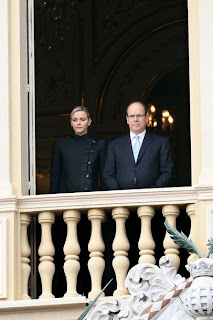 The Prince and future Princess of Monaco greet the crowds at the palace gathered to honor their patron Saint Devote.
 A mantilla at church always looks good to me.
 Charlene and Prince Albert II at mass
 The Prince and future Princess of Monaco greet the crowds at the palace gathered to honor their patron Saint Devote.
Monday, December 6, 2010
Pope Paul III

One of the popes with a special place in the history of Monaco was His Holiness Pope Paul III, the first Roman Pontiff to ever visit the principality. He was also a figure who embodied both good and bad aspects of the Renaissance papacy but also a great reformer. He was born Alessandro Farnese on February 29, 1468 in what was then the Papal States. His family, the Farnese, were a very old Italian family who had gained great success over the years and aside from gaining high position in the Church also became the Dukes of Parma. His mother was from the also well-placed Caetani family which included among its members the controversial Pope Boniface VIII in the Middle Ages. Young Alessandro Farnese was given the best education money could buy, studying at the University of Pisa and at the court of Lorenzo de Medici. Throughout his life he was immersed in the glorious atmosphere of Renaissance Italy. He learned to appreciate great art, great literature, philosophy and the art of unscrupulous political advancement.
In 1491 he was given a place in the Curia and in 1493 Pope Alexander VI made him a Cardinal-Deacon. He proved impressive and Pope Clement VII later made him Cardinal Bishop of Ostia and dean of the College of Cardinals. When the pontiff passed away Cardinal Farnese was elected pope in 1534 taking the name of Paul III. Like the stereotypical Renaissance pope, Paul III had four illegitimate children when he came to the papal throne and he quickly showed that the tradition of nepotism was still alive and well by appointing his teenage grandsons to the College of Cardinals. He later elevated his nephews to the rank of cardinal as well. However, also like other Renaissance popes, Paul III was a great patron of the arts. He employed Michelangelo in painting the “Last Judgment” in the Sistine Chapel, painting other frescos for the Vatican Palace as well as adding some finishing touches to the Farnese Palace in Rome. He commissioned numerous works of art and building projects adding to the beauty and defensibility of Rome.
On the political front Pope Paul III was an admirable champion of the Catholic Reformation. He clashed frequently with King Henry VIII of England. When the King determined to execute Bishop St John Fisher for refusing to recognize his marriage to his mistress, Pope Paul III infuriated King Henry by elevating Fisher to the rank of cardinal just before his execution. Later he took the ultimate step of excommunicating King Henry VIII for divorcing his first wife and defying the authority of Rome. On the continent Pope Paul III first supported the Holy Roman Emperor Charles V in his efforts to defeat a Protestant alliance called the Schmalkaldic League and restore all of Germany to the Catholic Church. However, when the Emperor proved successful Paul began to worry that a too-powerful German Emperor might be a danger to the Church and he withdrew his forces.
During this time Monaco was a protectorate of the Kingdom of Spain, of which the Holy Roman Emperor Charles V was king. It was the predecessor of Paul III, Pope Clement VII, who had advised Bishop Agustin Grimaldi, regent for Honore I, to ally with Spain and the Holy Roman Empire in the first place. It was while on his way to the Council of Nice that Pope Paul III stopped in Monaco for a visit, meeting with Seigneur Honore I who welcomed the Supreme Pontiff with all of the pomp and ceremony his tiny state could muster. Calling councils is one of the things Paul III is most remembered for. Despite his rather worldly reputation, Paul III was a great reformer who called the Council of Trent which finally got about the work of cleaning up the scandals in the Church that had provoked the birth of the Protestant movement. He also encouraged new religious orders which worked at reformation such as the Society of Jesus which he officially recognized in 1540. He also established the Roman Inquisition and condemned the enslavement of native Indians in the Americas. He died of fever at the age of 81 in 1549.
In 1491 he was given a place in the Curia and in 1493 Pope Alexander VI made him a Cardinal-Deacon. He proved impressive and Pope Clement VII later made him Cardinal Bishop of Ostia and dean of the College of Cardinals. When the pontiff passed away Cardinal Farnese was elected pope in 1534 taking the name of Paul III. Like the stereotypical Renaissance pope, Paul III had four illegitimate children when he came to the papal throne and he quickly showed that the tradition of nepotism was still alive and well by appointing his teenage grandsons to the College of Cardinals. He later elevated his nephews to the rank of cardinal as well. However, also like other Renaissance popes, Paul III was a great patron of the arts. He employed Michelangelo in painting the “Last Judgment” in the Sistine Chapel, painting other frescos for the Vatican Palace as well as adding some finishing touches to the Farnese Palace in Rome. He commissioned numerous works of art and building projects adding to the beauty and defensibility of Rome.
On the political front Pope Paul III was an admirable champion of the Catholic Reformation. He clashed frequently with King Henry VIII of England. When the King determined to execute Bishop St John Fisher for refusing to recognize his marriage to his mistress, Pope Paul III infuriated King Henry by elevating Fisher to the rank of cardinal just before his execution. Later he took the ultimate step of excommunicating King Henry VIII for divorcing his first wife and defying the authority of Rome. On the continent Pope Paul III first supported the Holy Roman Emperor Charles V in his efforts to defeat a Protestant alliance called the Schmalkaldic League and restore all of Germany to the Catholic Church. However, when the Emperor proved successful Paul began to worry that a too-powerful German Emperor might be a danger to the Church and he withdrew his forces.
During this time Monaco was a protectorate of the Kingdom of Spain, of which the Holy Roman Emperor Charles V was king. It was the predecessor of Paul III, Pope Clement VII, who had advised Bishop Agustin Grimaldi, regent for Honore I, to ally with Spain and the Holy Roman Empire in the first place. It was while on his way to the Council of Nice that Pope Paul III stopped in Monaco for a visit, meeting with Seigneur Honore I who welcomed the Supreme Pontiff with all of the pomp and ceremony his tiny state could muster. Calling councils is one of the things Paul III is most remembered for. Despite his rather worldly reputation, Paul III was a great reformer who called the Council of Trent which finally got about the work of cleaning up the scandals in the Church that had provoked the birth of the Protestant movement. He also encouraged new religious orders which worked at reformation such as the Society of Jesus which he officially recognized in 1540. He also established the Roman Inquisition and condemned the enslavement of native Indians in the Americas. He died of fever at the age of 81 in 1549.
Saturday, August 14, 2010
Monaco Defending the Faith

Monaco is on board with a plan to defend the Christian heritage of Europe. Metropolitan Hilarion, chairman of the Department of External Affairs of the Moscow Patriarchate, proposed the constitution of a “strategic alliance between Catholics and Orthodox” to defend the Christian traditions of Europe “against the secularism, liberalism and relativism that prevail in modern Europe”. The Russian Orthodox Church is not known for vague statements. This was prompted by the ruling last November against the display of crucifixes in Italian schools by the European Court of Human Rights. This has led to a coalition of some 20 countries from across Europe, Catholic and Orthodox, united in defense of the crucifix as a vital symbol of the religious heritage of the continent. Among those 20 is the Principality of Monaco which, while certainly allowing freedom of religion, recognizes the Roman Catholic Church as the official religion of the country as it always has been.
The ruling about crucifixes in Italian classrooms has taken on a much broader significance as people on both sides of the issue have seized on it as a symbolic struggle in the growing trend of secularization across Europe. Opponents of the ruling say that, since the court deemed that the state must be confessionally neutral the court effectively ruled that, regardless of history, heritage or the will of the popular majority, Europe must be entirely secular. The ruling means, rather oddly, that regardless of the democratic process any European country must be totally secular in order to be democratic. Supporters of the crucifix ban say that this issue is simply about religious freedom (the original lawsuit was brought by a Scottish convert to Islam living in Italy who objected to the presence of the crucifix in classrooms). However, while traditionally Catholic countries like France have officially become totally secular the neighboring Principality of Monaco has not and yet both have complete freedom of religion.
The Principality of Monaco was among the first ten countries to object to the court ruling alongside Armenia, Bulgaria, Cyprus, Greece, Lithuania, Malta, Romania, Russia and San Marino. Later on ten more countries; Albania, Austria, Croatia, Hungary, Macedonia, Moldavia, Poland, Serbia, Slovakia and the Ukraine have also joined the opposition to the ruling. Obviously, this opposition cuts across the traditionally deep divisions between Catholic and Orthodox countries, united now in common defense of the Christian heritage of Europe. With Italy, almost half of the founding nations of the Council of Europe have now voiced disapproval of the secularist policy. Prince Albert II has not been totally uninvolved in the campaign for closer ties between the Catholic and Orthodox communities. Regular readers will remember the Sovereign Prince awarding His All Holiness Ecumenical Patriarch Bartholomeos I for his efforts in this regard.
The ruling about crucifixes in Italian classrooms has taken on a much broader significance as people on both sides of the issue have seized on it as a symbolic struggle in the growing trend of secularization across Europe. Opponents of the ruling say that, since the court deemed that the state must be confessionally neutral the court effectively ruled that, regardless of history, heritage or the will of the popular majority, Europe must be entirely secular. The ruling means, rather oddly, that regardless of the democratic process any European country must be totally secular in order to be democratic. Supporters of the crucifix ban say that this issue is simply about religious freedom (the original lawsuit was brought by a Scottish convert to Islam living in Italy who objected to the presence of the crucifix in classrooms). However, while traditionally Catholic countries like France have officially become totally secular the neighboring Principality of Monaco has not and yet both have complete freedom of religion.
The Principality of Monaco was among the first ten countries to object to the court ruling alongside Armenia, Bulgaria, Cyprus, Greece, Lithuania, Malta, Romania, Russia and San Marino. Later on ten more countries; Albania, Austria, Croatia, Hungary, Macedonia, Moldavia, Poland, Serbia, Slovakia and the Ukraine have also joined the opposition to the ruling. Obviously, this opposition cuts across the traditionally deep divisions between Catholic and Orthodox countries, united now in common defense of the Christian heritage of Europe. With Italy, almost half of the founding nations of the Council of Europe have now voiced disapproval of the secularist policy. Prince Albert II has not been totally uninvolved in the campaign for closer ties between the Catholic and Orthodox communities. Regular readers will remember the Sovereign Prince awarding His All Holiness Ecumenical Patriarch Bartholomeos I for his efforts in this regard.
Friday, June 25, 2010
Religious Festivities in Monaco
 After making making the big announcement about his engagement, Prince Albert II, Princess Caroline and Princess Alexandra took in the local celebrations in honor of the feast of St John the Baptist. The little Princess of Hanover is really growing up fast.
 Princess Caroline points out to her Protestant daughter how Catholics do things...
 Prince Albert II teamed up with Princess Caroline again today for the opening of the "Buddha Bar" in Monte Carlo. A business geared toward over-indulgence in alcohol in a country famous for harboring the super-rich with a Buddhist theme...hmmm....somehow I doubt that the 'Enlightened One' would approve of his image being used in this way.
Subscribe to:
Posts (Atom)
