

Showing posts with label French Revolution. Show all posts
Showing posts with label French Revolution. Show all posts
Thursday, May 9, 2013
Bishop Louis-André de Grimaldi

Saturday, July 14, 2012
The Facts About Bastille Day


Monaco was, of course, much more fortunate than France. Most of the family survived, Monaco was ultimately given back her independence and the Sovereign Prince was restored to his rightful throne. The French monarchy was restored as well but, sadly, the Revolution had done too much damage in France. The mentality of the country had changed and the moral core of the country would never be quite the same again. The traditional monarchy would fall, replaced by another Kingdom of France that tried to reach an accomodation with the revolutionary mindset only to be undone in 1848 and all of this in between the two efforts at empire led by the famous Napoleon and his later nephew. It says something profound that, despite some minor problems, the Principality of Monaco in all that time has continued on in peace and ever-increasing prosperity, secure in the traditions of a centuries old monarchy led by a family everyone knows and loves while France had more revolutions, the Paris Commune and is currently on their fifth effort at a republic. Monaco has long depended on the protection of France but these facts, perhaps, suggest that France might benefit from taking a lesson from the little principality on her southern coast.
Vive le Roi!
Wednesday, February 16, 2011
The French Royal Martyrs and Monaco

Since starting this weblog, and preferring to talk about the history of the Grimaldis and Monaco more than current goings-on (though that isn’t always possible) I have often been asked about the relationship between the ill-fated French royals King Louis XVI and Queen Marie Antoinette and the Principality of Monaco. I have been hesitant in addressing this subject for a number of reasons but wanted to for others. In the first place, there is not much to tell. The short answer is that Louis XVI and Marie Antoinette had practically nothing to do with Monaco or the Grimaldis aside from the occasional social meeting. I also do not like making comparisons between royals that highlight the shortcomings of one side or another and yet I also did want to at least address this subject because I am a great admirer of the martyred French king and queen and would like to point out how unfair the popular portrayal of the couple remains. Unfortunately, that cannot really be done without reliving some of the unfortunate shortcomings of my dear Grimaldis. Be that as it may, let’s dive in.
Politically of course, the King of France and the Prince of Monaco were very close. The political situation was pretty much the same then as it is today. Monaco was, and still is, an independent protectorate of France. The Prince of Monaco, at the time Honore III, was a sovereign monarch but King Louis XVI of France was responsible for the protection of Monaco. However, the Grimaldis were much more important in France in the time of Louis XVI than they are now since the Princes of Monaco held lands and titles in the French aristocracy and so had a high place in the French court so, naturally, there were meetings between the two at Versailles and so on. However, Honore III was about 34 years older than Louis XVI so it would not be expected that they would be buddies or anything or even nearly as close as say Honore II and Louis XIII or Louis I and Louis XIV had been. However, even with the Hereditary Prince Honore IV, he and his wife, Princess Louise, Duchess de Mazarin, did not have much in common with Louis XVI and Queen Marie Antoinette.
The French King and Queen never visited Monaco, they rarely traveled at all and even the Princes of Monaco at that time were seldom in Monaco themselves. Prince Honore IV is something of a mysterious figure, only slightly younger than Louis XVI, since before the Revolution he was so overshadowed by his over-the-top wife and afterwards by his brother Prince Joseph who managed family affairs because Prince Honore IV was frequently ill. The marriage of Honore IV and Louise de Aumont Mazarin had been arranged and the two were completely incompatible with Princess Louise grabbing the most attention. As far as wives go, no two women were more opposite than Princess Louise and Queen Marie Antoinette. Not many people realize this because of the inaccurate portrayal of the French Queen but, as a matter of fact, the Hereditary Princess of Monaco was much closer to the way Marie Antoinette is so often accused of being.
No matter if one dismisses the most lurid tales as nothing more than court gossip there is no denying the fact that Princess Louise was a woman of rather loose morals who loved nothing more than wild and lavish parties with the most inventive costumes and diversions. Marie Antoinette is often portrayed this way but the truth is the total opposite. The King and Queen were both very religious people whereas the Grimaldis, although staunch Catholics of course, were not the most devout people in the world and Princess Louise certainly was not. Queen Marie Antoinette purposely did not associate with her because she so disapproved of her lifestyle, attitude and even her appearance. Whereas Marie Antoinette had a more delicate, childlike sort of beauty, Princess Louise was very voluptuous and bold and that type. So, Queen Marie Antoinette avoided Princess Louise specifically for behaving in ways that the Queen herself is so often accused of. It serves to illustrate how terribly unfair the popular portrayal of Marie Antoinette has been.
Prince Honore IV was nothing like his wife, which is one reason why they did not remain married for long, effectively parting before the revolution and divorcing during the period of the directory but even that was something the pious French King and Queen would not have approved of and could not have related to. In short, the two couples simply moved in different circles despite their proximity at the royal court in Versailles. And, even though Princess Louise in many ways embodied the sort of lifestyle Marie Antoinette was accused of being guilty of, the former Princess of Monaco would survive the revolution while the tragic Queen of course did not. Princess Louise, Duchess de Mazarin, with her husband Prince Honore IV and others of their family, were arrested by the revolutionaries but she managed to escape with her son, Prince Florestan, thanks to the kindly intervention of a doctor who was a family friend of the Grimaldis.
So, the House of Grimaldi ended up better off than their French counterparts, at least in as much as most of the Grimaldis survived the revolutionary bloodbath. They were eventually restored to their throne, as were the Bourbons, but the Grimaldis managed to stay whereas the French monarchy sadly did not. The families were close in political terms, friendly and correct and they both suffered due to the revolution. However, personally, they simply were not that close because they did not have a great deal in common and generally moved in different circles. Past kings had been much closer to the princes of Monaco but Louis XVI was quite different from his predecessors and neither he nor Honore IV were very “social” types. Their wives, contrary to popular belief, were as opposite as night and day. The Queen disapproved of the Princess of Monaco and the princess probably would have viewed the Queen as rather boring and prudish. For those who view Marie Antoinette as a consort unconcerned with her adopted country, unattached to her husband and given to extravagant spending and lavish parties they are actually giving an unfortunately accurate description of Princess Louise whom the Queen of France made it a point to avoid for those very qualities.
Politically of course, the King of France and the Prince of Monaco were very close. The political situation was pretty much the same then as it is today. Monaco was, and still is, an independent protectorate of France. The Prince of Monaco, at the time Honore III, was a sovereign monarch but King Louis XVI of France was responsible for the protection of Monaco. However, the Grimaldis were much more important in France in the time of Louis XVI than they are now since the Princes of Monaco held lands and titles in the French aristocracy and so had a high place in the French court so, naturally, there were meetings between the two at Versailles and so on. However, Honore III was about 34 years older than Louis XVI so it would not be expected that they would be buddies or anything or even nearly as close as say Honore II and Louis XIII or Louis I and Louis XIV had been. However, even with the Hereditary Prince Honore IV, he and his wife, Princess Louise, Duchess de Mazarin, did not have much in common with Louis XVI and Queen Marie Antoinette.
The French King and Queen never visited Monaco, they rarely traveled at all and even the Princes of Monaco at that time were seldom in Monaco themselves. Prince Honore IV is something of a mysterious figure, only slightly younger than Louis XVI, since before the Revolution he was so overshadowed by his over-the-top wife and afterwards by his brother Prince Joseph who managed family affairs because Prince Honore IV was frequently ill. The marriage of Honore IV and Louise de Aumont Mazarin had been arranged and the two were completely incompatible with Princess Louise grabbing the most attention. As far as wives go, no two women were more opposite than Princess Louise and Queen Marie Antoinette. Not many people realize this because of the inaccurate portrayal of the French Queen but, as a matter of fact, the Hereditary Princess of Monaco was much closer to the way Marie Antoinette is so often accused of being.
No matter if one dismisses the most lurid tales as nothing more than court gossip there is no denying the fact that Princess Louise was a woman of rather loose morals who loved nothing more than wild and lavish parties with the most inventive costumes and diversions. Marie Antoinette is often portrayed this way but the truth is the total opposite. The King and Queen were both very religious people whereas the Grimaldis, although staunch Catholics of course, were not the most devout people in the world and Princess Louise certainly was not. Queen Marie Antoinette purposely did not associate with her because she so disapproved of her lifestyle, attitude and even her appearance. Whereas Marie Antoinette had a more delicate, childlike sort of beauty, Princess Louise was very voluptuous and bold and that type. So, Queen Marie Antoinette avoided Princess Louise specifically for behaving in ways that the Queen herself is so often accused of. It serves to illustrate how terribly unfair the popular portrayal of Marie Antoinette has been.
Prince Honore IV was nothing like his wife, which is one reason why they did not remain married for long, effectively parting before the revolution and divorcing during the period of the directory but even that was something the pious French King and Queen would not have approved of and could not have related to. In short, the two couples simply moved in different circles despite their proximity at the royal court in Versailles. And, even though Princess Louise in many ways embodied the sort of lifestyle Marie Antoinette was accused of being guilty of, the former Princess of Monaco would survive the revolution while the tragic Queen of course did not. Princess Louise, Duchess de Mazarin, with her husband Prince Honore IV and others of their family, were arrested by the revolutionaries but she managed to escape with her son, Prince Florestan, thanks to the kindly intervention of a doctor who was a family friend of the Grimaldis.
So, the House of Grimaldi ended up better off than their French counterparts, at least in as much as most of the Grimaldis survived the revolutionary bloodbath. They were eventually restored to their throne, as were the Bourbons, but the Grimaldis managed to stay whereas the French monarchy sadly did not. The families were close in political terms, friendly and correct and they both suffered due to the revolution. However, personally, they simply were not that close because they did not have a great deal in common and generally moved in different circles. Past kings had been much closer to the princes of Monaco but Louis XVI was quite different from his predecessors and neither he nor Honore IV were very “social” types. Their wives, contrary to popular belief, were as opposite as night and day. The Queen disapproved of the Princess of Monaco and the princess probably would have viewed the Queen as rather boring and prudish. For those who view Marie Antoinette as a consort unconcerned with her adopted country, unattached to her husband and given to extravagant spending and lavish parties they are actually giving an unfortunately accurate description of Princess Louise whom the Queen of France made it a point to avoid for those very qualities.
Friday, January 21, 2011
The Death of a King
 It was on this day in 1793 that His Most Christian Majesty, King Louis XVI of France and Navarre was executed guillotine after being declared a "traitor" by the French Convention. As had been the case since the reign of King Louis XIII, the King of France was the official protector of the Principality of Monaco and feudal overlord of her princes. Now the Bourbon monarchy had been abolished and Louis XVI was sent to his death for his royal blood. In time his wife would follow him, also sent to the guillotine, and his little son and heir, the Dauphin, would be starved to death in a revolutionary prison. This news undoubtedly sent shock waves throughout the House of Grimaldi. If the French revolutionaries would kill their own king, whose person was once held sacred, what mercy could a deposed monarch of a foreign princely family expect? At the time, HSH Prince Honore III was himself in a revolutionary prison, his country had been torn from him and in due time would be absorbed completely by the French Republic. What horror Prince Honore III and his son Hereditary Prince Honore IV must have felt when this news reached their ears. No doubt they wondered when their own turn to face Madame Guiolltine would come. Thankfully, that day did not come save for the tragic Princess Francoise-Therese de Choiseul-Satinville, wife of Prince Joseph of Monaco.
Although they may not have felt it as severely as the Princes of Monaco sitting in prison in Paris, the whole world was shocked the regicide of Louis XVI and none moreso than the remaining crowned heads of Europe. However, the United States was also not without outrage on the occasion. It had, oddly enough, been Thomas Paine of Pennsylvania, the famous propagandist of the American Revolution who had really sold the American public on dropping their loyalty to the King of England, who was the single member of the Convention to vote against the execution of the King. Paine warned his fellow revolutionaries that America had not forgotten that it had been the intervention of King Louis XVI which had ensured their victory in the war for independence. As Paine said, 'The man you have condemned to death is regarded by the people of the United States as their best friend, the founder of their freedom'. He warned them that by killing King Louis they would instantly turn the United States from a friend to a foe of the Revolution. Although some supporters remained, by and large he was correct.
Wednesday, January 19, 2011
When Republicanism Came to Monaco

It was on this day in 1793 that the communes of Monaco, Menton and Roquebrune declared themselves a republic having previously declared themselves "free towns" in 1792. Only the previous week the revolutionary clubs had deposed HSH Prince Honore III (who was in France desperately trying to save his estates there from the revolutionary crowd). They were, obviously, following the example of the gang in power in Paris which was working feverishly to tear down the Bourbon monarchy and the Kingdom of France. However, if the new "Republic of Monaco" thought they were going to be close allies and best buddies with the new France (as the Principality of Monaco and the Kingdom of France had been) they were sorely mistaken. Even at the time observers noted how comical the whole act seemed to be.
Three deputies from the Republic of Monaco came to the National Assembly in France to seek the confirmation of the Franco-Monegasque alliance with them. The two articles in the new treaty stated, "There shall be peace and alliance between the French Republic and the Republic of Monaco" and, "The French Republic is delighted to make the acquaintance of the Republic of Monaco". That sounds all nice and friendly but, as Louis XVI or Honore III could have told them, the revolutionary regime was not exactly noted for honesty and fair-dealing. If Monaco thought that by following their republican example they could continue on as they had before only with their own political clique holding power rather than the House of Grimaldi they were very much mistaken. It would not be long (less than a month) before the French Republic decided to annex the whole of Monaco (Menton and Roquebrune included at that time) and the former principality became simply a forgotten little corner of the French Republic, renamed Fort Hercules just so there would be no lingering memories of the past Grimaldi glories of the Principality of Monaco.
Thankfully, although it would take time, this situation was not to be permanent. Like their Bourbon friends the Grimaldis were finally restored to their throne, though unlike the Bourbons they have managed to remain ever since with absolutely no nostalgia for the republican era when independence was lost.
Thursday, January 13, 2011
A Sad Day in History
 It was on this day in 1793 that HSH Prince Honore III was deposed as Sovereign Prince as the French Revolution overflowed into Monaco. The Prince had rushed to Paris in 1790 when the trouble there began to try (unsuccessfully) to safeguard his lands and titles in the French aristocracy (as the Duke of Valentinois). In 1792 French revolutionaries and those whipped into a frenzy by them had already declared Monaco, Menton and Roquebrune "Free Towns" before, on January 13th, deposing Honore III and declaring, "the perpetual downfall of the sovereignty of the House of Grimaldi". The Prince of Monaco had already been thwarted in his efforts in Paris following the imprisonment of King Louis XVI and Queen Marie Antoinette in the Tuileries. The Assembly had recognized that he had a case but nothing was done about it and as the Assembly had turned on their own monarch and were treating their own Royal Family as political prisoners, the foreign Prince of Monaco seemed totally out of luck. His only remaining hope was that the more moderate faction of Mirabeau could make France a constitutional monarchy and some level of normalcy could be restored. However, in the meantime, the so-called "People's Councils" of Monaco, Menton and Roquebrune had formed a Conventional Assembly and deposed Prince Honore III. So it was that while he was trying to restore his properties in France, the Prince had lost his very throne in his own country.
We can at least be thankful that this outbreak of revolution in Monaco was not accompanied by the sort of horrific bloodlust that was seen in France. Nonetheless, it was a terrible blow to the Princely Family and the start of what would be a long, dark period in the history of Monaco. No longer having a place in their own country, the Grimaldis were at the mercy of the increasingly radical "government" in France which soon saw them arrested (even the elderly Honore III) and in real fear of their lives as a succession of French aristocrats were sent to the guilotine. Helpless in a foreign land, Honore III tried to gain the good graces of those in power but it was to no avail. The French revolutionary madness was not to be turned back and little Monaco had been swamped by the flood that had burst through in Paris. It would be twenty years before the Prince of Monaco (by that time Honore IV) would be restored to his country and Monaco again restored to the status of a sovereign country.
Saturday, January 8, 2011
Louis Joseph, Prince de Condé

Louis Joseph, Prince de Condé, had more than a few connections with the Grimaldi Princely Family during the tumultuous period of the French Revolution which saw the Kingdom of France destroyed and the Principality of Monaco annexed to the French Republic. He was born Louis Joseph de Bourbon on August 9, 1736 to Louis Henri Duc d’Bourbon and Landgravine Caroline of Hesse-Rotenburg. As a prince of the blood he was a member of the very highest echelon of French society. His grandmother, in fact, was the daughter of King Louis XIV by his famous mistress Madame de Montespan. His father died in 1740 and his mother the following year and Louis Joseph was raised by his uncle the Comte d’Clermont. By his mother he was related to the House of Savoy and to a whole horde of French royals and aristocrats on the side of his father. On May 3, 1753 he married Charlotte Elisabeth Godefride de Rohan, granddaughter of the Duc d’Bouillon at Versailles.
Soon the father of three (though one daughter did not long survive) the Prince de Condé busied himself with building projects, attending court and overseeing the upbringing and beneficial marriages of his children. His was a very familiar face at the courts of King Louis XV and King Louis XVI as well where he held the rank of Grand Maître de France in the King’s household. The military was also a long established duty and the Prince de Condé saw action in the Seven Years’ War (known in America as the French and Indian War) and rose to the rank of general, also serving for a time as Governor of Burgundy. However, life in France was soon to take a very dark turn with the growing discontent that eventually led to the outbreak of the French Revolution. Up to this point there was not much of a connection between the Prince de Condé and the House of Grimaldi. They would have met at court where the Prince of Monaco was well known and since the Princes of Monaco were also members of the French aristocracy. The Revolution, however, would bring the Grimaldi and the Condé together.
 Sensing the trouble to come, when the Paris mob stormed the Bastille in 1789 the Prince de Condé went into exile, saving himself from what would surely have been certain death in the Reign of Terror that followed. To be a Bourbon in France at the height of the terror was almost as good as a death sentence. The King, the Queen and even the Duc d’Orleans were executed in 1793. That same year Prince Honore III of Monaco was deposed and later arrested, his country annexed to the French Republic and renamed Fort Hercules. His son and heir, Honore IV, was arrested in Paris with his father, but his second son, Prince Joseph of Monaco had fled with his wife into exile. While in exile Prince Joseph of Monaco made common cause with Prince Louis Joseph de Condé who was organizing a royalist army at Coblenz in 1791, made up mostly of French exiles, with the aim of returning to France to liberate their country from the forces of the revolution and the rule of Madame Guillotine.
The Army of Condé, as it came to be called, included a long list of famous names from the French aristocracy and Royal Family. Aside from the Prince de Condé and Prince Joseph of Monaco there was the Duc d’Enghien (grandson of the Prince de Condé), the Comte d’Artois (brother of the late King Louis XVI), the Duc d’Richelieu, the Duc d’Blacas and Chateaubriand and so on. Originally they fought alongside the imperial forces of Austria until squabbling between the two forces compelled the Prince de Condé to transfer his men to the British jurisdiction in 1795. However, that year was to see the last of Prince Joseph in the ranks, though his presence had already cost him dearly. Word that he had joined the counter-revolutionary forces of the Prince de Condé reached Paris and when his wife returned to France to see about their children she was discovered, arrested and sent to the guillotine in 1794. She was the last victim of the terror and the more moderate forces that took charge after allowed Prince Joseph to return to France to take charge of family affairs after the death of his father.
 The Prince de Condé, however, continued onward with his mission, fighting in Swabia in 1796 before being forced to transfer to Poland and join with the Imperial Russian Army when Austria made peace with the republic in 1797. When Russia left the allied camp in 1800 the Prince returned his forces to the British camp, undoubtedly not an easy thing to do for a man who was a veteran of the Seven Years’ War. The Prince and his army fought in Bavaria but was disbanded in 1801 without ever seeing their dream of the liberation of France and the restoration of the monarchy come to fruition. The Prince de Condé went into exile in England where he lived with his second wife, none other than Marie Catherine de Brignole-Sale, the ex-wife of Prince Honore III of Monaco, whom he had married in 1798. In fact, it was the Prince de Condé, already the smitten kitten, who had helped obtain the final break between the then Princess of Monaco and her husband while she had taken refuge in a convent following after Honore III had been driven to fury by the affair his wife had been having with the Prince de Condé in Paris.
In any event, the former Princess of Monaco spent herself into poverty supporting French royalists and their cause, which was also the cause of her husband, until her death in 1813, so much so in fact that the British Royal Family had to step in to help with the funeral expenses. When Napoleon Bonaparte was finally defeated the Prince de Condé was able to return to Paris and take up his place again in the French court after the restoration of King Louis XVIII. He died in 1818 leaving two children; his son who succeeded to his title and his daughter who had taken vows and risen to become abbess of Remiremont Abbey. He was buried in St Denis Basilica.
Soon the father of three (though one daughter did not long survive) the Prince de Condé busied himself with building projects, attending court and overseeing the upbringing and beneficial marriages of his children. His was a very familiar face at the courts of King Louis XV and King Louis XVI as well where he held the rank of Grand Maître de France in the King’s household. The military was also a long established duty and the Prince de Condé saw action in the Seven Years’ War (known in America as the French and Indian War) and rose to the rank of general, also serving for a time as Governor of Burgundy. However, life in France was soon to take a very dark turn with the growing discontent that eventually led to the outbreak of the French Revolution. Up to this point there was not much of a connection between the Prince de Condé and the House of Grimaldi. They would have met at court where the Prince of Monaco was well known and since the Princes of Monaco were also members of the French aristocracy. The Revolution, however, would bring the Grimaldi and the Condé together.
 Sensing the trouble to come, when the Paris mob stormed the Bastille in 1789 the Prince de Condé went into exile, saving himself from what would surely have been certain death in the Reign of Terror that followed. To be a Bourbon in France at the height of the terror was almost as good as a death sentence. The King, the Queen and even the Duc d’Orleans were executed in 1793. That same year Prince Honore III of Monaco was deposed and later arrested, his country annexed to the French Republic and renamed Fort Hercules. His son and heir, Honore IV, was arrested in Paris with his father, but his second son, Prince Joseph of Monaco had fled with his wife into exile. While in exile Prince Joseph of Monaco made common cause with Prince Louis Joseph de Condé who was organizing a royalist army at Coblenz in 1791, made up mostly of French exiles, with the aim of returning to France to liberate their country from the forces of the revolution and the rule of Madame Guillotine.
The Army of Condé, as it came to be called, included a long list of famous names from the French aristocracy and Royal Family. Aside from the Prince de Condé and Prince Joseph of Monaco there was the Duc d’Enghien (grandson of the Prince de Condé), the Comte d’Artois (brother of the late King Louis XVI), the Duc d’Richelieu, the Duc d’Blacas and Chateaubriand and so on. Originally they fought alongside the imperial forces of Austria until squabbling between the two forces compelled the Prince de Condé to transfer his men to the British jurisdiction in 1795. However, that year was to see the last of Prince Joseph in the ranks, though his presence had already cost him dearly. Word that he had joined the counter-revolutionary forces of the Prince de Condé reached Paris and when his wife returned to France to see about their children she was discovered, arrested and sent to the guillotine in 1794. She was the last victim of the terror and the more moderate forces that took charge after allowed Prince Joseph to return to France to take charge of family affairs after the death of his father.
 The Prince de Condé, however, continued onward with his mission, fighting in Swabia in 1796 before being forced to transfer to Poland and join with the Imperial Russian Army when Austria made peace with the republic in 1797. When Russia left the allied camp in 1800 the Prince returned his forces to the British camp, undoubtedly not an easy thing to do for a man who was a veteran of the Seven Years’ War. The Prince and his army fought in Bavaria but was disbanded in 1801 without ever seeing their dream of the liberation of France and the restoration of the monarchy come to fruition. The Prince de Condé went into exile in England where he lived with his second wife, none other than Marie Catherine de Brignole-Sale, the ex-wife of Prince Honore III of Monaco, whom he had married in 1798. In fact, it was the Prince de Condé, already the smitten kitten, who had helped obtain the final break between the then Princess of Monaco and her husband while she had taken refuge in a convent following after Honore III had been driven to fury by the affair his wife had been having with the Prince de Condé in Paris.
In any event, the former Princess of Monaco spent herself into poverty supporting French royalists and their cause, which was also the cause of her husband, until her death in 1813, so much so in fact that the British Royal Family had to step in to help with the funeral expenses. When Napoleon Bonaparte was finally defeated the Prince de Condé was able to return to Paris and take up his place again in the French court after the restoration of King Louis XVIII. He died in 1818 leaving two children; his son who succeeded to his title and his daughter who had taken vows and risen to become abbess of Remiremont Abbey. He was buried in St Denis Basilica.
Wednesday, July 14, 2010
Bastille Day
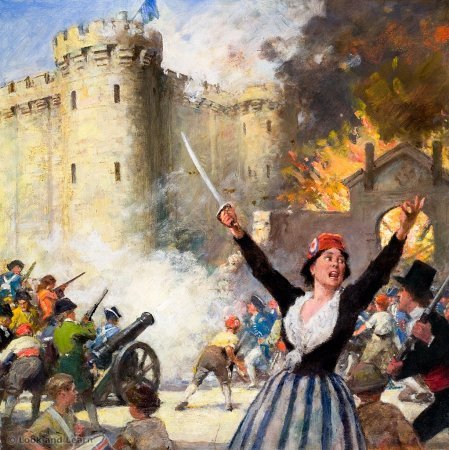
 Today the republicans of France celebrate the storming of the Bastille, usually used as a way to mark the start of the French Revolution. The "accepted" viewpoint is that the Bastille represented tyranny and oppression and the storming of the Bastille and the subsequent revolt was a glorious uprising of the people for 'liberty, equality and brotherhood'. However, facts can often get in the way of a good, rabble rousing story. The fact is that the Bastille was ugly and imposing but was not a terrible prison. At the time of the storming it held only a few petty criminals and lunatics. Moreoever, the Revolution that followed did not deliver freedom and liberty but a horrific bloodbath, known even at the time as the "Reign of Terror" which was not finally ended until the imposition of the authoritarian regime of Napoleon. It was not a battle between suffering masses and a cruel elite, in fact it was the poor common people who suffered the most and far more of them were murdered than were aristocrats. It was a terrible turn of events that brought greater suffering than anyone in Europe at that time had ever seen.
The storming of the Bastille also set events into motion that led to misery and suffering for France's neighbor Monaco. Shortly after the Bastille fell the revolutionary instigators infiltrated the lands of the Prince of Monaco and encouraged uprisings and demands for government power in Monaco, Menton and Roquebrune. HSH Prince Honore III was caught in a desperate situation. He allowed the formation of independently elected councils in the towns of his domain to appease his subjects and then rushed to Paris to try to save his considerable estates as a member of the French nobility. On August 4, 1789 he lost everything with the adoption of the abolition of all feudal rights and privileges in France. Promises were made to compensate him as he was a foreign prince and the Grimaldis had been given their French titles as payment for services to France but nothing ever came from it. The Grimaldis and Monaco were pulled down into the abyss that was the French Revolution.
The Prince de Conde (whose paramour was Honore III's ex-wife) gathered the royalist emigres to fight for the Kingdom of France and Prince Joseph of Monaco (a veteran of the Lorraine Dragoons and the Royal-Cravate) joined them. On October 22, 1792 French revolutionary forces occupied Monaco which Honore III protested but could not stop and his petitions were ignored. A Monegasque branch of the Jacobin Club, a radical bloodthirsty society led by the notorious executioner Robespierre, was set up in Monaco and the palace was ransacked by a revolutionary mob. In January of the next year they finally got around to arranging a "vote" to depose Honore III and allow Monaco to be annexed to France. Relegated to a mere cantonal seat in the Alpes-Maritimes department the "People's Council" voted to change the name of Monaco to Fort d'Hercule.
These were the darkest days for the House of Grimaldi. Prince Honore III, old and soon to die, tried to get back simply his own personal property but even this was denied him. Prince Joseph went into exile and Honore III and his son Honore IV were thrown in prison by the revolutionary regime. Honore IV's ex-wife Louise-Felicite and their son Prince Florestan were also put in prison. All of the property of the Grimaldi and Mazarin families were confiscated and Princess Francoise-Therese, the beloved wife of Prince Joseph, went to the guillotine as the last victim of the Reign of Terror. Ironically it was on that very day, 9 Thermidor on the revolutionary calendar, that Robespierre himself, the instigator of the nightmarish bloodlust, was arrested by his own revolutionary cohorts. That would not be the end of the ordeal and anyone observing the situation could have understood the Grimaldis and the people of Monaco giving up. Thankfully, they did not and their fortunes were ultimately restored but the spiral downward, toward revolution, occupation, terror and death all started today, July 14, in 1789 with the storming of the Bastille.
Sunday, March 21, 2010
This Day in History
 On this day in 1795 HSH Prince Honore III (left) passed away at the age of 74 in Paris and was succeeded by his son HSH Prince Honore IV. It was a dark time for the Grimaldi family; their French estates had been taken by the Revolution, many members of the family had been put in prison and Monaco itself was taken over by the French republicans with even the Princely Palace being seized and looted. Prince Honore III had been in prison the year before his death, which ruined his already weakening health. Prince Honore IV thus succeeded to his rights as Sovereign Prince of Monaco but could not actually take up that position and was a man without a country. He had been in prison when the Reign of Terror broke out and Honore IV was thrown in prison. His confinement was cruel and was to ruin his health to a large extent, even long after his release he was frail and sickly for the rest of his life. It must have seemed like the most hopeless position for Honore IV when he inherited the title of Sovereign Prince of Monaco; his family in prison or in exile, his country occupied, the family fortune gone and revolutionary radicals in control and preaching war and conquest. However, Prince Honore IV would eventually see his country restored but it all started with his succession on March 21, 1795.
Thursday, January 21, 2010
Monaco and the Regicide of Louis XVI
 It was today in 1793 that His Most Christian Majesty King Louis XVI of France was beheaded by revolutionaries in Paris. This tragic event had a huge impact, not only on France, but on the neighboring Principality of Monaco as well. The French Revolution had already spread to Monaco, a Jacobin club was established on "The Rock" itself and HSH Prince Honore III had gone to Paris in an effort to save his rights and lands as a member of the French aristocracy. In the end, although the revolutionary government recognized the right of Honore's claim, he was given none of the compensation promised to him and a month after the regicide of the King the French republic took over Monaco and Honore III was deposed. The Princely flag was torn down and the French tricolor took its place.
This is something that Monegasque monarchists should keep in mind as it can be tempting to view Monaco as an isolated enclave of paradise, safe from the trials and tribulations of the outside world. Ever since Prince Honore II led his coup against the Spanish and brought Monaco under the protection of Louis XIII of France the two countries have had a special relationship which endures to this day. However, it is worth remembering, lest anyone think it does not matter to Monaco whether France is a monarchy or a republic, that the only time France ever violated Monegasque sovereignty it was the French republic that did so. No King of France ever invaded or in any way harmed the nation of Monaco -but the republic did. In fact, the Kings of France and the Princes of Monaco enjoyed a very friendly relationship, helping each other in many instances.
The French Revolution was a disaster for Monaco and the death of Louis XVI should be remembered with sadness in Monaco as much as in France for a benevolent protector was taken from them unjustly. As the tumult reached its zenith Monaco would be taken over by the French republic, the Princely Palace looted and occupied and the Grimaldi family deposed, thrown into prison and in the case of one tragic princess, sent to the guillotine. Fortunately for Monaco, the Grimaldi monarchy was restored and reigned without interruption ever since. While revolution and republicanism brought a succession of governments to France in all the years since, Monaco has remained peaceful and stable under their Princely Family. This simple fact is one French republicans should perhaps give some consideration.
Rest in peace King Louis.
Subscribe to:
Posts (Atom)
