Tuesday, September 13, 2011
Sunday, September 11, 2011
Saturday, September 10, 2011
Accession Day of Albert I
It was on this day in 1889 that HSH Prince Albert I succeeded his father (Charles III) as Sovereign Prince of Monaco. Under his leadership, the character of Monaco was to change a great deal as the principality became a center for scientific research, culture and peace. Although his father had never understood his fascination with the sea, Prince Albert I established the Oceanographic Institute of Monaco which has grown in prestige ever since and remains a major center for oceanographic research to this day. His interest in archaeology also prompted him to found the Institute for Human Paleontology and the actions of his consort, Princess Alice, brought high culture to Monaco in the form of the opera, ballet and theater. When the threat of world war began to appear on the horizon, Prince Albert founded the International Institute of Peace in Monaco to try to find a way to avoid such a disaster and having been a veteran of the Franco-Prussian War, the Prince was only too aware of what horrors resulted from the last time the French and Germans had had at each other. When the war came anyway, he intervened with the German Kaiser, who had been his friend, to lessen the suffering of people in Belgium and Alsace and he established hospitals and recovery centers in Monaco for the Allied soldiers. He was a great man and widely respected all around the world, the first Prince of Monaco to be known in America as well as Europe (he was the first Grimaldi to visit the United States) and it was quite traumatic when he died in 1922, honored by the people of Monaco and scientific societies all around the world.
Thursday, September 8, 2011
Grimaldi News & Views
Tuesday and Wednesday saw HSH Prince Albert II in Brussels, Belgium for a conference on -you guessed it: the environment! In this case the forests of Europe and the world. Meeting at the European Parliament the Prince of Monaco spoke with the intensity and sincerity he always shows for environmental issues, the cause closest to his heart, and addressed the impact of climate change (the artist formerly known as 'global warming') on the woodlands of the world.
Also on Tuesday, Prince Albert teamed up with 'big sis' Princess Caroline to take in a new exhibit by famed filmmaker and photographer Nick Danziger called "War and Peace: Women in the XXI Century". The exhibit focused on the plight of women in the many conflicts of our time, pointing out that it is they who often suffer the most. It brought to mind a line my mother often quoted, "War is hell on the home front too, God only knows what a woman goes through..." The exhibit will run until the end of the month.
And finally, there is more bad news for the nutjob with the 'notgays' who is obsessed with Prince Albert. His case against Monaco was recently thrown out by a French court on the grounds that one grumpy old man with a grudge and too much time on his hands cannot sue an entire country. He only resorted to that when his case against the Prince himself was thrown out on the grounds of sovereign immunity. So far, he seems to have a hard time accepting the lesson that 'crime doesn't pay'. But, one must do something when you get too old to go on being a professional fraud.
Also on Tuesday, Prince Albert teamed up with 'big sis' Princess Caroline to take in a new exhibit by famed filmmaker and photographer Nick Danziger called "War and Peace: Women in the XXI Century". The exhibit focused on the plight of women in the many conflicts of our time, pointing out that it is they who often suffer the most. It brought to mind a line my mother often quoted, "War is hell on the home front too, God only knows what a woman goes through..." The exhibit will run until the end of the month.
And finally, there is more bad news for the nutjob with the 'notgays' who is obsessed with Prince Albert. His case against Monaco was recently thrown out by a French court on the grounds that one grumpy old man with a grudge and too much time on his hands cannot sue an entire country. He only resorted to that when his case against the Prince himself was thrown out on the grounds of sovereign immunity. So far, he seems to have a hard time accepting the lesson that 'crime doesn't pay'. But, one must do something when you get too old to go on being a professional fraud.
Tuesday, September 6, 2011
Happy (Belated) Birthday Pierre
Yesterday, Pierre Casiraghi celebrated his 24th birthday. Mad for Monaco hopes Pierre had a happy one and looks forward to many, many more.
Sunday, September 4, 2011
Friday, September 2, 2011
Thursday, September 1, 2011
Monaco-Serbian Friendship
HRH Crown Prince Alexander II of Serbia, HSH Princess Charlene of Monaco, HRH Crown Princess Katherine of Serbia and HSH Prince Albert II of Monaco
HSH Princess Charlene of Monaco and HRH Crown Princess Katherine of Serbia
The House of Grimaldi and the House of Karađorđević have been good friends for some time now and it was good to see Serbian royal couple at the recent princely wedding. The Serbian Crown Prince is, I think, probably the most impressive non-reigning royal around today. He has been very successful in forging close ties with the existing Serbian government and the Orthodox Church and has done a great deal of good for the Serbian people. He has stayed out of politics but has been very active in advocating for a constitutional monarchy in his long-suffering homeland. Serbia will be a great deal better off when they finally correct past injustices and make Alexander their King. I'm sure the Prince and Princess of Monaco would be happy to attend his coronation.
Tuesday, August 30, 2011
King Carlo Alberto and Monaco
It was during the reign of HSH Prince Florestan, aided by his ever-diligent wife Princess Caroline, that the crisis over Menton and Roquebrune reached its height. The one royal figure on the other side of that crisis was HM King Carlo Alberto of Piedmont-Sardinia, head of the House of Savoy which held a partial protectorate over the Principality of Monaco since the Napoleonic Wars, including Menton and Roquebrune. When liberal outbursts began to sweep Europe, and the southern areas particularly, some royals tried to suppress the spread of such sentiments while others tried to get out in front of them. King Carlo Alberto tried to get out in front, perhaps belatedly, but quite successfully. It was a course of action that put him on a path to conflict with the Prince of Monaco. However, King Carlo Alberto was not quite the scheming man of ambition many of his enemies make him out to be. At the outset he was simply following the example seemingly being set by other monarchs and even the Holy Father in Rome. The difference was, having set out, he refused to change course. The two driving forces behind this movement were constitutional government and nationalism. This is the background.
In 1846 His Holiness Pope Pius IX was elected to the Throne of St Peter and came with a reputation for being something of a liberal, a man known for the demands he had made for governments to care for their people and for his recognition of the people of the Italian peninsula as one nation. Naturally, liberals rejoiced when he was elected and further thrilled when he released from the prisons in Rome all of those jailed for sedition or revolution or any sort of what we would call political prisoners. He appointed progressives to positions of leadership and began the unheard of process of introducing constitutional government in the Papal States with a leadership made up entirely of laymen. King Carlo Alberto followed the example of the Pope and soon in the Principality of Monaco, particularly Menton, there were cheers for Pope Pius IX and King Carlo Alberto by those hoping for the same innovations to be handed down from their Prince. However, the Pope who was so celebrated by liberals and even Protestant governments eventually became horrified by the effects of his progressive changes and ultimately became known as one of the most ardently conservative or even reactionary of pontiffs.
King Carlo Alberto, on the other hand, did not change course. His convictions may have even been strengthened by the sight of the Pope being forced to flee Rome in disguise and then brought back only by the intervention of the French army. The King of Piedmont-Sardinia would stay on the more liberal track and came to be hailed by Italian nationalists as the one monarch who never betrayed them. This meant clashes with other crowned heads, most significantly the Austrian Hapsburgs rather than the relatively powerless Prince of Monaco but it would also mean that, in the end, the House of Savoy would become the Royal Family of the unified Kingdom of Italy in the not too distant future. So, King Carlo Alberto enacted many liberal changes, including constitutional government, a system which hearkened back to the Code Napoleon but which also modeled itself somewhat on the constitutional monarchy of Great Britain which seemed to work quite well. New rights and liberties were granted and troublesome elements in Menton seized on this to demand the same in the Principality of Monaco. Many residents, even in Monaco itself as late as the 1940’s, continued to think of themselves as Italians in ethnic terms and the nationalist drive toward creating an Italian nation-state had its supporters in the Principality of Monaco.
This put Prince Florestan in a terrible position. He was no reactionary himself and, indeed, Monaco would eventually put all the demanded changes into effect, but he did not want to see his country divided or taken over by a foreign power. The problem was that the power he most feared, Piedmont-Sardinia, was the only one he was supposed to appeal to for help. Charles Trenca, a leading liberal, was an early flashpoint. He had served the House of Grimaldi since 1819 and in 1841 he had been sent on a diplomatic mission to Turin along with the Duke of Valentinois (future Prince Charles III) and King Carlo Alberto had been impressed with him. On a subsequent mission the King chose him to act as go-between with the court in Monaco on the subject of annexing Monaco to Piedmont-Sardinia. Needless to say, Prince Florestan and Princess Caroline were less than impressed with this suggestion and Trenca was eventually dismissed for his plotting on behalf of Turin.
King Carlo Alberto had showed his hand and his desire to include Monaco or at the least Menton and Roquebrune in his kingdom was now known. However, the agitation in those areas only increased even after reforms were made and Prince Florestan had no choice but to appeal to the King for Piedmontese troops to restore order. When soldiers were dispatched under General Claudio Gonnet to Menton they were met by a crowd of citizens carrying a large bust of their own beloved King Carlo Alberto. They could not bring themselves to shoot down a mob cheering their own monarch and when the crowd approached, carrying the bust before them, they simply saluted the image of their King and allowed them to pass at which point the crowd burst into cheers. General Gonnet declared that there was no trouble in Menton and marched his troops on to Monaco to report as much to the Prince. This did not go over well at the palace and they assumed, probably correctly, that General Gonnet was on the side of the protestors in wishing for annexation.
When the Revolutions of 1848 swept Europe, Menton and Roquebrune declared their secession from Monaco as “Free Cities” when similar uprisings were breaking out across Italy. Within two years they would be formally placed under the protection of the Kingdom of Piedmont-Sardinia. However, King Carlo Alberto would not live to see that. Following his defeat at the hands of the Austrians in the First Italian War for Independence, he abdicated in favor of his son, Vittorio Emanuele II, in 1849 and died later that same year. Piedmont-Sardinia would not hold the former Monegasque towns for long though. As we know, in 1860, as part of a treaty to gain French support for the unification of Italy by the House of Savoy, the County of Nice, with Menton and Roquebrune included, were ceded to the Second French Empire after a referendum, disputed by some as being less than honest. Nonetheless, aside from a brief period during World War II, Menton and Roquebrune have remained a part of France ever since then.
In 1846 His Holiness Pope Pius IX was elected to the Throne of St Peter and came with a reputation for being something of a liberal, a man known for the demands he had made for governments to care for their people and for his recognition of the people of the Italian peninsula as one nation. Naturally, liberals rejoiced when he was elected and further thrilled when he released from the prisons in Rome all of those jailed for sedition or revolution or any sort of what we would call political prisoners. He appointed progressives to positions of leadership and began the unheard of process of introducing constitutional government in the Papal States with a leadership made up entirely of laymen. King Carlo Alberto followed the example of the Pope and soon in the Principality of Monaco, particularly Menton, there were cheers for Pope Pius IX and King Carlo Alberto by those hoping for the same innovations to be handed down from their Prince. However, the Pope who was so celebrated by liberals and even Protestant governments eventually became horrified by the effects of his progressive changes and ultimately became known as one of the most ardently conservative or even reactionary of pontiffs.
King Carlo Alberto, on the other hand, did not change course. His convictions may have even been strengthened by the sight of the Pope being forced to flee Rome in disguise and then brought back only by the intervention of the French army. The King of Piedmont-Sardinia would stay on the more liberal track and came to be hailed by Italian nationalists as the one monarch who never betrayed them. This meant clashes with other crowned heads, most significantly the Austrian Hapsburgs rather than the relatively powerless Prince of Monaco but it would also mean that, in the end, the House of Savoy would become the Royal Family of the unified Kingdom of Italy in the not too distant future. So, King Carlo Alberto enacted many liberal changes, including constitutional government, a system which hearkened back to the Code Napoleon but which also modeled itself somewhat on the constitutional monarchy of Great Britain which seemed to work quite well. New rights and liberties were granted and troublesome elements in Menton seized on this to demand the same in the Principality of Monaco. Many residents, even in Monaco itself as late as the 1940’s, continued to think of themselves as Italians in ethnic terms and the nationalist drive toward creating an Italian nation-state had its supporters in the Principality of Monaco.
This put Prince Florestan in a terrible position. He was no reactionary himself and, indeed, Monaco would eventually put all the demanded changes into effect, but he did not want to see his country divided or taken over by a foreign power. The problem was that the power he most feared, Piedmont-Sardinia, was the only one he was supposed to appeal to for help. Charles Trenca, a leading liberal, was an early flashpoint. He had served the House of Grimaldi since 1819 and in 1841 he had been sent on a diplomatic mission to Turin along with the Duke of Valentinois (future Prince Charles III) and King Carlo Alberto had been impressed with him. On a subsequent mission the King chose him to act as go-between with the court in Monaco on the subject of annexing Monaco to Piedmont-Sardinia. Needless to say, Prince Florestan and Princess Caroline were less than impressed with this suggestion and Trenca was eventually dismissed for his plotting on behalf of Turin.
King Carlo Alberto had showed his hand and his desire to include Monaco or at the least Menton and Roquebrune in his kingdom was now known. However, the agitation in those areas only increased even after reforms were made and Prince Florestan had no choice but to appeal to the King for Piedmontese troops to restore order. When soldiers were dispatched under General Claudio Gonnet to Menton they were met by a crowd of citizens carrying a large bust of their own beloved King Carlo Alberto. They could not bring themselves to shoot down a mob cheering their own monarch and when the crowd approached, carrying the bust before them, they simply saluted the image of their King and allowed them to pass at which point the crowd burst into cheers. General Gonnet declared that there was no trouble in Menton and marched his troops on to Monaco to report as much to the Prince. This did not go over well at the palace and they assumed, probably correctly, that General Gonnet was on the side of the protestors in wishing for annexation.
When the Revolutions of 1848 swept Europe, Menton and Roquebrune declared their secession from Monaco as “Free Cities” when similar uprisings were breaking out across Italy. Within two years they would be formally placed under the protection of the Kingdom of Piedmont-Sardinia. However, King Carlo Alberto would not live to see that. Following his defeat at the hands of the Austrians in the First Italian War for Independence, he abdicated in favor of his son, Vittorio Emanuele II, in 1849 and died later that same year. Piedmont-Sardinia would not hold the former Monegasque towns for long though. As we know, in 1860, as part of a treaty to gain French support for the unification of Italy by the House of Savoy, the County of Nice, with Menton and Roquebrune included, were ceded to the Second French Empire after a referendum, disputed by some as being less than honest. Nonetheless, aside from a brief period during World War II, Menton and Roquebrune have remained a part of France ever since then.
Sunday, August 28, 2011
Prince Albert, Football Fan
On Friday, HSH Prince Albert II was alongside good friend UEFA President Michel Platini at the Louis II Stadium in Monaco for a football match between FC Barcelona and FC Porto. Onlookers were a little disappointed not to see Princess Charlene accompanying her husband, but of course I speak of 'real life' people who like the princess, not the clique of 'e-people' who have had it in for her from the start. They ignored the game, the smiling prince, the laughter and conversation between two old friends and zoomed in on one thing: the lack of a wedding ring on the Prince's finger. Aha! "This proves it!" they exclaimed, "this means there really IS trouble in paradise!". Well, don't get your hopes up you twisted people. And, seriously, what sort of deeply hateful person has to obsess over two people finding happiness together and getting married, whoever they are? As I mentioned last post, the Princely couple is fine, there are no problems, they are doing great. Anyone can look at the pictures of the two of them, whether together or apart and all you will see is two happy people going about their daily lives. The absence of a wedding ring (and this is not even the first time since the wedding the Prince has been spotted without one) means absolutely nothing. In fact, I could find it a little bit insulting. My parents have been happily married for many decades and I have never seen my father wear his wedding ring in my entire life. The only reason I know it exists is because my mother showed it to me once while putting some clothes away (he kept it in his sock drawer with other valuables). Likewise, I don't remember my grandfather ever wearing his wedding ring and he was happily married to my grandmother from 1941 until the day he died. Move on people -there's nothing to see here.
Also, some have asked if the Grimaldi dynasty was represented at the wedding of HIRH Prince Georg Friedrich of Prussia this weekend in Germany. The answer to that would be "no". Not many high-profile royals attended the event, it being, after all, a marriage between two royals whose status is unrecognized by their current government. It also might have been a little uncomfortable for them to do so given that HRH the Prince of Hannover was there. However, that is not to say that there are any problems between the German and Monegasque royals. In fact, Prince Albert I of Monaco, our Albie's namesake and great-great grandfather, was quite good friends with Prince Georg Friedrich's great-grandfather Kaiser Wilhelm II (both of them being yachting enthusiasts). So, no problems between the Grimaldis and Hohenzollerns but Germany is just a little bit outside the 'orbit' of the Principality of Monaco these days.
Friday, August 26, 2011
Princess Charlene, Doing Fine
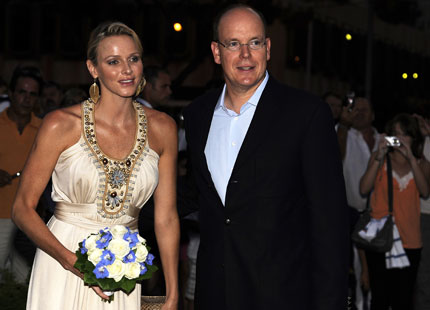
Since her first official engagement at the Red Cross Ball, HSH Princess Charlene of Monaco has been keeping a pretty busy schedule. She and the Sovereign Prince re-opened the Van Cleef & Arpels boutique (which now includes a Charlene Salon), then there was a classic music festival in the neighboring town of Menton (once a part of the Grimaldi dominion many years ago), where the new Princess let her hair down and was given a very warm welcome -and a *very* large armfull of flowers, from the adoring crowd and then, last Friday both attended the 50th anniversary of the Stade Nautique Rainier III where, again, the welcome was exuberant. No gaffes, no stumbles, no "scenes" and not a hint of trouble, just a Prince and Princess of Monaco, comfortable, at ease and still newlyweds who (as you can tell from the many photos of each occasion) still have a hard time taking their eyes off each other. If all of those who were trying to cast doubts and who made a habit of saying unkind things could see just how silly -and sad- they look based on the example of the Princely couple, well, perhaps it would all stop.
What is even more telling, considering all the "doom and gloom" so many were spouting, is the public reaction at every place the new couple have visited, whether in France, Monaco or one of the nearby towns within the 'Monegasque community'. I wonder if the gloomy gus types realize how out of touch they are? On each and every occasion the welcome has been warm and exuberant, even moreso than the always polite and friendly welcome given to the Sovereign Prince, who is a familiar face in these areas, but there are huge cheers for Princess Charlene, very large and very long rounds of applause, shouts of best wishes and as many photographs as possible. In short, the people love them. They see them, up close, they see what a happy couple they are, comfortable and at ease with each other (which they should be by now) and your average person without a heart full of malice is instantly attracted to that. Princess Charlene, despite a great deal of negativity hurled her way right out of the gate, has gotten off to an excellent start as the new Princess of Monaco. She has not let the naysayers get her down but, as the British used to say, has simply kept calm and carried on. Good for her and well done.
Wednesday, August 24, 2011
Favorite Princely Images: Spain and Monaco
HM King Juan Carlos I of Spain and HSH Princess Grace of Monaco. The Spanish Royal Family and the Princely House of Monaco have long been good friends, carrying on a close relationship that is centuries old, dating back to when Monaco was within the Spanish sphere of influence. That didn't turn out so well, but the countries and their Royal Families are friends again. Recent generations have been particularly close since, as we know, Queen Victoria Eugenia of Spain was Prince Albert's godmother and a close friend of Princess Grace when she was still the "new princess on the block".
Subscribe to:
Posts (Atom)