Monday, May 31, 2010

Memorial Day

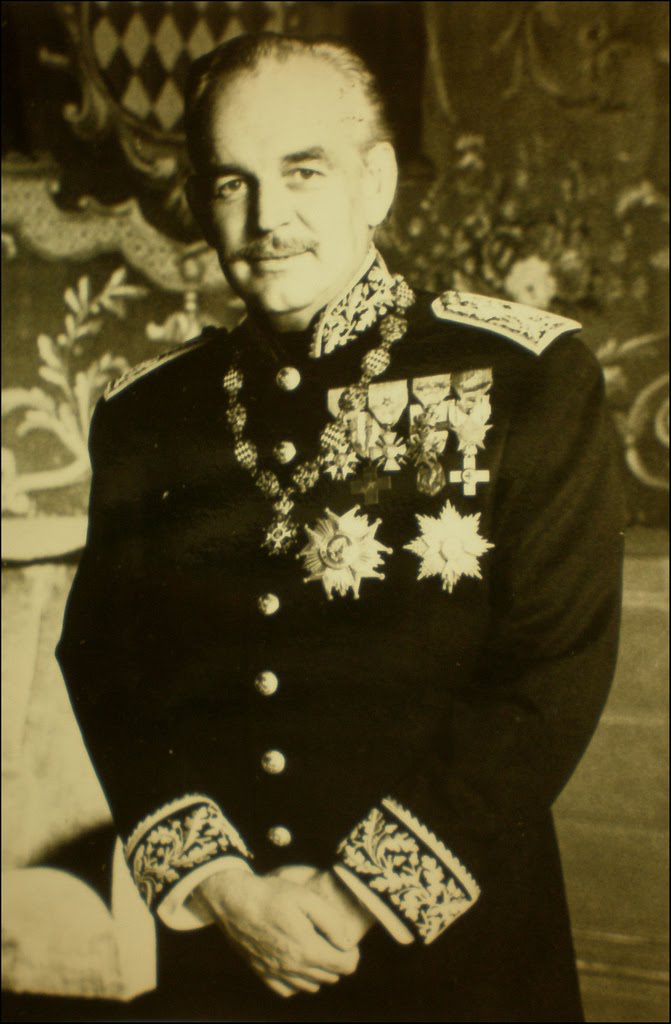
Today holds a special significance in the Principality of Monaco and the United States of America. It was on this day in 1923 that HSH Prince Rainier III was born to Princess Charlotte and Prince Pierre of Monaco and across the US those who have died in military service are honored on Memorial Day. Thankfully, none of the recent relatives of the Princely Family (on either the Monegasque or American side) have died in war but a number have seen military service. John B. Kelly Sr. (better known as Jack Kelly), father of Princess Grace and grandfather of Prince Albert II of Monaco, enlisted as a private in the US Army during World War I and by the time the conflict had ended had been promoted to the rank of lieutenant. His son, John Kelly Jr, brother of Princess Grace and uncle of the current Princely Family, served in the US Navy during World War II but was stationed in Maryland. During the war, when he was given leave, his sister Grace would drive him to and from his base and the family home in Philadelphia. Prince Albert II himself also served for one month in the US Navy as was mentioned below.
Although not remembered as part of the American holiday of Memorial Day, readers will know that there is a long tradition of military service in the Grimaldi family of Monaco. Prince Rainier III served in the French army during World War II and his father, Prince Pierre, gave a great deal of covert assistance to the Free French forces during the dark days of the occupation. Prince Louis II served with great distinction in the French army during World War I. Even though he could not serve in World War II, Louis II donned his French uniform during the war years so there would be no doubt as to where his sympathies were among the warring powers.

Sunday, May 30, 2010

Recent Grimaldi News

Nostalgia was in the air on the 27th in Brest where Prince Albert and Vice Admiral Jean-Pierre Labonne visited the French aircraft carrier "Joan of Arc" which put in to port for the last time. The warship, a training vessel in the French navy, holds a special significance for the Prince of Monaco as he served on the ship during his 'military hitch' from September 1981 to April 1982, carrying on the long Grimaldi family tradition of service in the armed forces. The ship was launched in 1964 and was the longest-serving vessel in the French fleet. In 1980 Prince Albert also served for 1 month on a ship in the US Navy.
On the same day HRH Princess Caroline was at the Princess Grace Hospital in Monaco to visit all of the new mothers and their babies on the occasion of Mother's Day in Monaco. This has become a nice new tradition. Last year it was Princess Stephanie who visited the new mommies.

Friday, May 28, 2010

The Princely Palace of Monaco

The Princely Palace of Monaco is one of the oldest monarchial homes in the world that is still in use today. Just as it has been for centuries past the Princely Palace is still the official residence of the Monegasque sovereign and, as such, is the heart of the political and social life of Monaco. Part of the unique beauty of the palace is the blending of styles, part modern Mediterranean palace, part medieval fortress, sharing Italian and French styles as well as others. This all goes back to the palace being originally built as a military fortress, a castle, by the Genoese republic in 1191. In 1297 the castle was taken by the House of Grimaldi but the transition from military bulwark to princely palace took a long time.

Over the centuries the Princely Palace that was once a castle was attacked many times, fought over in numerous small wars including Monaco and often changed hands. Seigneur Charles I of Monaco (r. 1331-1357) expanded the fortifications and constructed new buildings which saw the first shift in style from that of a military base to a residential home. Further expansions were made under Lords Lambert and Jean II, however, battles and skirmishes continued off and on until a lasting sense of peace and security was established by the alignment with the Kingdom of France. That, of course, was during the reign of HSH Prince Honore II.

A man of refined taste and a Francophone, Honore II embellished the palace with the works of some of the greatest artists of the Renaissance period and more or less completed the change from castle to palace. By the time his reign ended he had made it a place any French or Italian prince would be comfortable in, as able to entertain as to defend. In the years that followed the Princely Palace was further refined and decorated until it became known as the ‘Versailles of the Mediterranean’. Louis I spent lavishly on furnishings, his son Antoine more on defensive works as the threat of war crept closer to Monaco again. However, with the rise of Louis XIV in France and the importance attached to the court at Versailles a long period ensued in which most Princes of Monaco spent most of their time in France rather that at home.

Some additional work was done during the reign of Honore III, though he was also often absent, and it was during his reign that the Duke of York died in the palace, giving his name to one of the bedrooms. However, toward the end of his reign the outbreak of the French Revolution brought ruin and occupation to Monaco. The Princely Family was arrested in France, the country occupied, the palace looted and later turned into a military hospital and poor house for the revolutionaries. When the Revolution and Napoleonic Wars had passed and the House of Grimaldi was restored the palace had deteriorated considerably and some areas had to be demolished and replaced with new structures.

The rebuilding and restoration increased under Prince Charles III who was the next monarch to actually spend most of his time in Monaco. He went to great lengths to try to recover as much as possible of the art work and family treasures that had been stolen and dispersed at the time of the Revolution. Subsequent monarchs, however, spent much of their time abroad and the palace lingered in the rather gloomy atmosphere it acquired during the long period of Charles’ infirmity. This did not change until the arrival of Prince Albert I and his second wife, Princess Alice. Although the sovereign was often at sea, Princess Alice put her own touch on the palace and society life in Monaco as she encouraged art, learning, music and dance. The place became something of a haven for intellectuals alongside the flow of visitors of every stripe to the booming casino at Monte Carlo.

Prince Louis II did not spend much of his life in Monaco, being in the field with the French army most of the time, his most lasting legacy being the opening of the Napoleonic museum at the palace where the bathing pavilion of Honore II had once stood. However, when his successor Rainier III married the American film icon Grace Kelly the Princely Palace was steadily lived in again and, for the first time in a long time, became a family home. Princess Grace redecorated, which drew some snide comments about what were perceived as California styles, but such attitudes did not last long. Rainier and Grace also oversaw the restoration of much of the priceless artwork at the palace while carrying out their own renovations, mostly geared toward making the palace a more practical home. It was also under Rainier III that the palace became part office as the home base of the big business that was the Grimaldis’ Monaco.

Today, although again often traveling, Prince Albert II still maintains his formal residence at the Princely Palace which, in recent years, has become as much a tourist attraction as many other Monegasque landmarks. State rooms are open to the public in the summer months, parts have the appearance of a museum, but the smart changing of the guard every day reminds all that it is still a monarchial residence.

Wednesday, May 26, 2010

Seigneur Jean I of Monaco


When Lord Rainier II of Monaco died in 1407 the Grimaldi legacy was left to his three sons; Ambroise, Antoine and Jean. They worked out an agreement, when the time came, to rule Monaco jointly, with each one taking a turn every year. Jean I was 25 when his father had passed away and, rather typically for a Grimaldi of his era, was described as “adventurous and enterprising”. Considering this it is no surprise that he found gainful employment as a soldier of fortune; hiring out his soldiers and galleys to the service of Philippe-Marie Visconti, Duke of Milan, the Holy Roman Emperor Sigismund, the Pope and the Duke of Anjou in turn.

At the time, Louis III of Anjou who was locked in a war with the Duras family over Provence. The towns in the region passed back and forth between the two factions, though even when Louis III occupied Monaco his forces were often more of a plague than protection. Nonetheless, Jean, Ambroise and Antoine were loyal and total control of Monaco was restored to them. Genoa was also anxious to have an alliance with the house of Anjou and so surrendered their own claims on Monaco to ingratiate themselves. This allowed the brothers to return to Monaco in 1419 and it was then that they officially declared themselves co-seigneurs of Monaco in the triumvirate that was to last for seven years. When Antoine and Ambroise surrendered their own claims on The Rock in exchange for Menton, Roquebrune and Jean’s estates in La Turbie Lord Jean I became the sole ruler of Monaco.

After the brothers saw to it that the treaties made by their predecessor Lord Charles I were all renewed in an effort to ensure the independence of Monaco but after taking part in a war against the Duke of Milan they were defeated. The Duke of Savoy wanted Monaco obliterated and a Milanese garrison occupied the town. However Jean was a very skilled sailor and Francisco Sforza hired him to fight the Venetians on the Po. He won a great victory there against the famous Carmagnola in 1431. Because of this his lands in Monaco were restored but as vassals of the dukes of Milan. That same year it was Lord Jean I of Monaco who was charged with transporting the East Roman (Byzantine) Emperor John VIII Palaeologus from Constantinople to the Council of Basil in the hope of bringing the divided halves of Christendom together again. However, the tempermental Emperor refused to go with Lord Jean and when he returned without his guest Jean I was defeated by Francesco Sforza of Milan.

While Jean was away the Duke of Savoy fell upon Monaco and when Jean returned he was treacherously taken prisoner. However, showing how far back the history of strong, determined women is in the Grimaldi family, it was the wife of Jean I, Pomelline Fregose, who took in hand the defense of Monaco and she did not relent even when the Jean was hauled out under the ramparts to intimidate her. She vowed to never surrender and Jean managed to get word to her that she should not submit even if he should be killed, either by the enemy or fire from his own men while under the ramparts. The Duke of Savoy finally gave up and released Jean the following year. In 1440 the Duke of Milan renounced his feudal rights over Monaco which then became totally independent again.

Jean I had been loyal to Philippe-Marie Visconti when he was Duke of Milan and it was Visconti whom the Genoese had chosen as their governor. When he died in 1447 (replaced by the Ambrosia Republic) the by now rather aged Jean I sought out his old enemy the Duke of Savoy to be protector of Monaco. In exchange for this he offered parts of Menton and Roquebrune which obviously led to trouble later on. Jean also reportedly considered selling Monaco to the Dauphin of France for 15,000 gold pieces but this was never done as the scheme the Dauphin had to invade Italy was dropped and he had no need of the port of Monaco. At the end of his life Jean I had one pressing issue to deal with and that was the succession. His only children to survive to adulthood were his son Catalan and his daughter Bartholomeé and of Catalan’s children the only survivor was his daughter Claudine.

On April 5, 1454 Lord Jean I drew up the official rules of succession for the House of Grimaldi. The rules stated that succession would pass to legitimate offspring in the male line in order of birth. Only if there were no male heirs could an eldest daughter succeed on the condition that she marry, “a man belonging either to the direct lineage or to the albergo of the Grimaldis” and that he and his descendants must take the name and the coat of arms of the Grimaldi family. These rules of succession have remained mostly unchanged ever since. Lord Jean I died that same year having ruled over Monaco on three occasions, alone or in cooperation with his brothers. He was succeeded by his son Catalan who lasted only three years longer.

Monday, May 24, 2010

Rainier III: A Man & Monarch of Integrity

For someone as widely known as the late Prince Rainier III of Monaco, many people have an inaccurate impression of the man. Part of this is undoubtedly due to his association with his country. Monaco, for all of its charm and glamour, has long been known as a center of gambling, a place where fortunes are lost, a tax haven and, as has been famously stated, “a sunny place for shady people”. Because of this background, his family history, his wealth and perhaps his movie star wife, Rainier III is often thought of as a man of possibly less than impeccable character. Some have portrayed him as an unscrupulous, Mediterranean rogue while others have portrayed him as a simple, uncouth man who, in the words of Peter Kurth, “would rather watch television and eat pizza in his underwear” than go to parties.

True enough, Rainier III took his royal duties more seriously than the society pages (he being one of the few remaining monarchs expected to actually rule his country) and he did not like the shallowness and snobbery of the jet-set elite he is so often grouped with. However this negative image of Prince Rainier is quite unfair and quite the opposite of the truth. People go through subtle changes in their lives but taken as a whole Rainier III was, contrary to what most people think, a man devoted to his country, his family and his faith. In the first place, he was the first Prince of Monaco in quite sometime to make Monaco his primary residence. He wanted to live amongst his people and very much saw the native Monegasque population as one big extension of his own family. Foreign settlers and visitors were always welcome of course, but the Monegasque were his people and he was theirs.

In fact, part of the reason for the famous clash between Rainier III and Aristotle Onassis was that Rainier III wanted Monaco to be a tourist destination that welcomed people from all classes of society rather than catering exclusively to the super-rich. Much of what many took for aloofness with Rainier III was actually shyness, which was part of his character from childhood. He preferred things more formal and ‘by the book’ because he was often uncomfortable dealing with people in an informal, familiar setting. He was a genteel man but also down-to-earth, as comfortable with the courtly ceremony of the palace as he was making pancakes for his children for breakfast at their home in the country.

The Prince of Monaco was also a very religious man, an aspect of his character that is certainly not often talked about. When he came to the Monegasque throne upon the death of his grandfather Prince Louis II, one of his very first acts was to go to Rome to receive the blessing of Pope Pius XII upon his reign. One of his closest friends and probably his most trusted advisor was Father Francis Tucker, an American priest the Vatican had assigned to the Prince to be his spiritual advisor. When he began to seriously search for a wife the Prince went on a pilgrimage to Lourdes to, as he told his spiritual advisor, seek the help of the Holy Virgin in finding the right wife and princess consort. The result, of course, was his marriage to Grace Kelly (whose patron saint was the visionary of Lourdes as it turned out). Prince Rainier even sought the advice of the Pope himself on religious matters from time to time and he donated 4,500,000 francs to the Church every year. When reforming the constitution of Monaco he also specifically forbid abortion in his realm for any reason.

Despite the aura of permissiveness that most seem to assume regarding Monaco and the House of Grimaldi, while certainly not prudish or saintly, Rainier III always had very traditional values. Some failings he could overlook as natural if unfortunate but he was quite intolerant of flagrant immorality and perversity. Unfortunately, this is all too often forgotten today or reduced to a simple statement about the Prince not approving of homosexuality or the cause of “gay rights”. He was extremely distraught over the private lives of his daughters, such as the expected divorce of Princess Caroline from Philippe Junot and he went to great lengths to ensure that everything was done correctly according to the doctrines of the Catholic Church, finally obtaining (belatedly) the annulment he had long sought for her which legitimized her children by Stefano Casiraghi, placing them in line for the Monegasque throne. As much as he adored his daughters, his traditional views did at one point force him to shun Princess Stephanie for her behavior, though thankfully the two were later reconciled and became closer than they ever had been.

Finally, as stated above, Prince Rainier was a committed family man. He had a short temper at times and could sometimes be short with Princess Grace but he was a devoted husband and father. Gossip-mongers tried their best to imply that he was an unfaithful husband, even manipulating photographs to show him sitting closer to some pretty woman at a party than was reality. In truth, no such thing ever happened and any honest witness could see the subtle signs that the marriage of Grace and Rainier remained strong throughout their years together. He adored her from start to finish and upon her death was heard to lament, “My life will never be the same…Without Princess Grace none of it matters for me now. It’s all meaningless. My God, it’s all meaningless”. He was much more active father than he often gets credit for, particularly in regards to his son.

The true character of the Prince in this regard is not hard to see if one takes into account his own painful youth. He was deeply torn by the failed marriage of his parents and the bitter feelings between them. He knew how much this hurt him as a child and he was determined, from the first time he started seriously seeking a wife, that for his family things would be different. He wanted his children to have a more stable, loving and traditional family and family support than he had growing up. He did not want to repeat the mistakes of the past. Of course he could not control the lives of his children, he recognized when mistakes were being made and there was never any doubt about when he was displeased with their occasional behavior. In the rush to criticize it is also easy to forget that, at the end of the day, Grace and Rainier did raise three generous, compassionate and good-hearted children. At the end of the day, despite the impression many have, he was a devoted and loving father, a faithful husband, a defender of traditional values, a staunch Catholic, conscious of his position as sovereign of a Catholic monarchy and, as a sign of how he was viewed by the Church, one of the very few members of the Papal Order of the Golden Spur, the oldest papal order in Church history. He was not pure and perfect in every way, no one is, but the impression many seem to have of him is certainly far from accurate. The real Prince Rainier was, overall, an upstanding man and monarch.

Saturday, May 22, 2010

Caroline Joins Albert at Yacht Club

After some 'alone time' on the Pacha III, Princess Caroline was back, looking good as ever, a day or two ago at the Exhibition of Doez Green and Toxic at the Monaco Yacht Club. Her son Pierre Casiraghi was also spotted at the event. Princess Caroline was greatly missed at the festivities surrounding the Monaco Grand Prix and the Cannes Film Festival but she was in seemingly very good spirits for the exhibition. Her time off seems to have done her good and, in spite of all she's been through lately, it is very nice to have her home again and every appearance she has made since reminds again of how well she has played her part as the "first lady" in the Principality of Monaco. Probably my favorite appearance was when she took little Princess Alexandra along to the picnic and garden party thrown by the mayor of Monacoville -it's always nice to see mother and daughter together on such occasions and it's always nice to see the close connection between the Grimaldis and the native Monegasques, keeping the traditions alive. I hope the Sovereign Prince didn't take it too hard that all the attention this time was on his previously absent big sister, but it's good to see Caroline out and about again.

Thursday, May 20, 2010

The Grimaldis Take Monaco

Once Monaco came under the protection of Genoa it steadily grew. The fortifications were strengthened, there was a permanent garrison that was heavily armed and documents from 1252 even mention an “old castle” and a “new castle” which would seem to imply there were two. So it was no small task when the Grimaldi clan took it upon themselves to rest Monaco from Genoese control. As we have discussed before the conflict came about as a result of the struggle in Genoa between the Guelph and Ghibelline factions. The Guelphs were driven out of Genoa and into the protecting arms of Charles d’Anjou, comte de Provence. However, despite the Ghibellines taking over Genoa and being in a seemingly strong position they had not counted on the tenacity and aggressiveness of the House of Grimaldi. They planned a surprise attack on the main fortress on The Rock at Monaco.

This operation was taken in hand, famously, by Francesco Grimaldi, also known as Francesco (or Francois) the Cunning. Others called him Francesco Malizia or “Francis the Malicious”. It was the night of January 8, 1297 -picture it. A clear, cold night on The Rock, jutting out into the sea with the roar of waves crashing at the base. Atop the rock stands an imposing castle. There is a knock at the door. A sleepy guard finally responds, looking out to see a rugged, bearded man in the hooded brown robe of a Franciscan monk. The guard asks what the man wants. He replies that he is a poor monk, simply seeking shelter for the night. The tired guard opens the door, after all, Guelph or Ghibelline, they are all Christians.

If the guard had been paying closer attention he might have noticed that the monk was not barefoot or heard a slight clinking noise of metal on metal as the man came through the door. But, it was too late -Francesco Grimaldi pulled his sword from under his robe and dropped the guard with a single blow. He pulled back his hood and waved his companions in from the door. From around the walls Guelph soldiers dashed into the fortress, including Francesco’s stepson Rainier Grimaldi, future first Seigneur de Monaco. The first Ghibelline soldiers were wiped out in minutes and through the night the Guelph soldiers fought their way through the castle. Imagine the cold dark night, the castle perched high on The Rock, the screams from within drowned out by the crashing waves. Did any soldiers fall from the battlements onto the jagged cliffs or pounding surf below? Perhaps so, perhaps not, none of the details are known to history, just the basic fact that the attack happened. By the time dawn broke The Rock, and with it all of Monaco, was in the hands of the House of Grimaldi.

That night in 1297 was the start of the modern history of Monaco as we know it and the start of Grimaldi rule which has continued, with occasional interruption, to this day. The event is commemorated throughout Monaco. A number of stamps have featured the nighttime attack or Francesco Grimaldi. A statue of the intrepid Guelph stands in front of the Princely Palace and the event is symbolically represented on the Grimaldi coat-of-arms which feature two men dressed as monks brandishing swords.

Tuesday, May 18, 2010

Casiraghis at Cannes

Saturday night Charlotte and Andrea Casiraghi, with their significant others, attended the Vanity Fair and Gucci Party honoring famed director and filmmaker Martin Scorsese during the 63rd annual Cannes film festival. The party was held at the Hotel Du Cap Eden Roc in Cannes. The stars were out that evening, also showing up were Jennifer Lopez and Marc Anthony, Benicio del Toro, Meg Ryan, Kate Beckinsale, Salma Hayek, Naomi Campbell and Queen Noor of Jordan. The above picture was taken at the Chopard 150th anniversary party where Charlotte arrived accompanied by her mother's longtime friend Khadija Nin which happened last night. All this events surrounding the Cannes film festival would seem to explain the absence of Andrea and Charlotte at the Grand Prix gala Sunday night.

MM Video: Caroline - Grace and Strength

Monday, May 17, 2010

Historic Birthday

It was on this day in 1758 that HSH Prince Honore IV of Monaco was born. He was the eldest son of Prince Honore III of Monaco and his wife Princess Marie-Catherine de Brignole-Sale. He had a rather tragic life among the princes of Monaco. He inherited his throne when there was no throne to inherit as Revolutionary France had taken over Monaco and exiled the Grimaldis. He suffered from chronic depression, which was not helped by his controversial wife Princess Marie-Felicite. His health was further ruined serving in Napoleon's forces. He saw his principality restored but was too ill to actually rule. He abdicated in 1815, four years before his death.

More on Grand Prix de Monaco

Charlotte Casiraghi tries to look fiercely gorgeous while Charlene Wittstock waves to the crowd.
Charlotte and Charlene - who will blink first?

Charlene Wittstock and Andrea Casiraghi

Charlotte hands out the second place trophy. Pierre gave out the 3rd place, Andrea the constructor's trophy and of course Prince Albert II presented the first place winner with his trophy.

Related Posts Plugin for WordPress, Blogger...