Showing posts with label France. Show all posts

Wednesday, April 30, 2014

Prince Honors the Legion


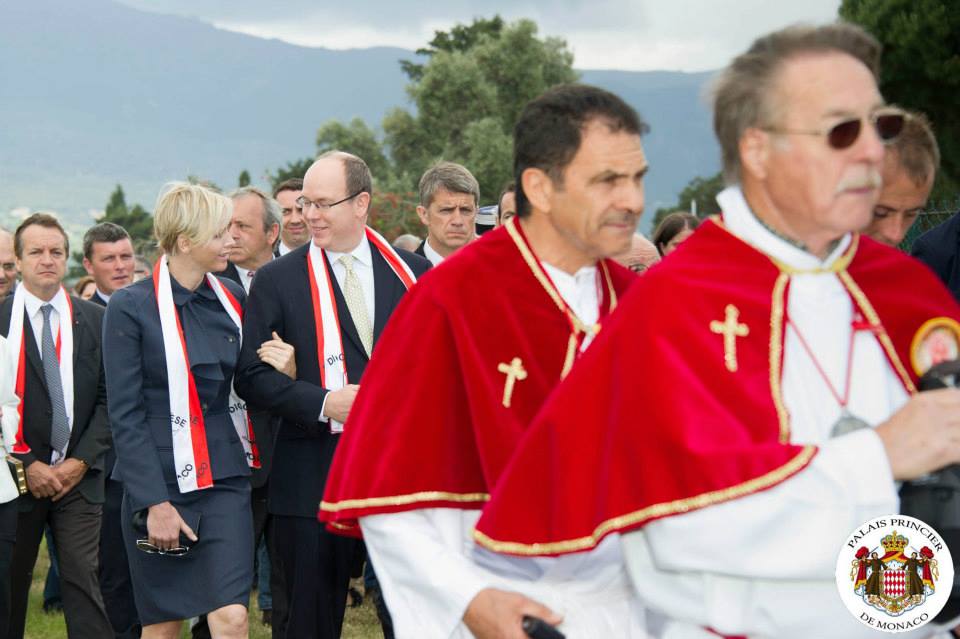
Recently, HSH Prince Albert II of Monaco was in Aubagne as guest of honor for the commemoration of the battle of Camerone, the official holiday of the French Foreign Legion. This marks a battle fought in Mexico in which a small band of less than a hundred legionnaires fought to the death against a Mexican republican army that numbered in the thousands. This was during the intervention of Emperor Napoleon III, just prior to the establishment of the Second Mexican Empire. The Sovereign Prince was very honored to participate and recalled the proud stories of his great-grandfather, HSH Prince Louis II, who served in the Foreign Legion in North Africa. Members of the Prince's carabinieri still train with the Legion from time to time as part of the military cooperation between France and Monaco. Andrea and Pierre Casiraghi have both participated in such exercises in the past.

Friday, May 24, 2013

Ancestral History and a Pilgrimage

Recently, HSH Prince Albert II was in France visiting one of the former estates of the Grimaldi; the former Duchy of Valentinois (Duke of Valentinois still being one of the titles of the prince). In Chabeuil the Sovereign Prince visited the old Hotel des Princes and opened the Place "Marie-Pelline Grimaldi of Monaco, maid of Chabeuil". Marie-Pelline was the daughter of Prince Antoine I of Monaco and gained lasting fame thanks to the harpsichord piece written for her by Francois Couperin. Prince Albert II visited some other historic villages and landmarks in the area, met with local officials and even took the "Promenade des Princes de Monaco" in Buis-les-Baronnies as well as attending the medieval festival in Crest (bet that was fun). The Duchy of Valentinois was ceded to the House of Grimaldi a year after the Treaty of Peronne in 1641 between King Louis XIII of France and Prince Honore II of Monaco which ended the Spanish protectorate over Monaco and by which the Kingdom of France recognized and guaranteed the independence of the Principality. Although the title is still retained, the actual Duchy of Valentinois was lost to the Prince of Monaco during the French Revolution and the abolition of the Bourbon monarchy.
On Tuesday TSH Prince Albert II and Princess Charlene visited the French island of Corsica on a pilgrimage to Bastia honoring St Devote, the patron saint of Monaco and the House of Grimaldi. St Devote is also patron saint of Corsica and Monegasque survival of a French-Corsican attack on the tiny country is attributed to the miraculous intervention of St Devote who is said to have appeared over the Monegasque battlements to reprimand the attackers, particularly the Corsicans who so revere her.

Saturday, December 8, 2012

The Prince and the President

In their first formal meeting, French President Francois Hollande welcomed HSH Prince Albert II of Monaco to the Elysee Palace for a 'working lunch' to discuss matters of common interest and boost Franco-Monegasque relations. As I'm sure all regular readers know, the Principality of Monaco has a "special relationship" with the French Republic in that, while remaining a sovereign state, the principality is a protectorate of France and France has traditionally had considerable influence in the micro-monarchy on their southern coast.

"And how about this global warming huh?"

"Well, thanks for the lunch Monsieur, we'll have to have you over to the palace someday"

"Goodbye Frenchie friends, I love ya!"

"See you later guys, I won't be far away"

Sunday, August 12, 2012

Rainier I and the Franco-Flemish War

Lord Rainier I was renowned as a great sailor, particularly for his part in the victory of the English and Flemish fleet at the battle of Zierikzee. Long before that he had a reputation for naval excellence in the service of King Charles II of Anjou and against the Ghibellines. But what was the background of the conflict that brought him to his most celebrated victory? It started with a campaign that would have sounded familiar to Napoleon Bonaparte many centuries later. King Philippe IV of France had determined that the way to cripple the power of England was to cut her off from trade with the European continent. Toward this end he undertook a diplomatic campaign to effectively create a blockade of England. His efforts were quite successful with rulers from Sicily to the Baltic closing their ports to English ships. England was soon becoming more and more weakened and the formidable King Edward I determined that something had to be done about this. However, England was not much of a naval power in those days and Edward I realized that he needed an ally that was.

Flanders was the place the English king looked to. A trading people even then, the blockade of England had hurt the Flemish economy, making them more open to the idea of an alliance with England, and the Flemish were renowned sailors. In 1297 King Edward I and Count Guy of Flanders signed the Treaty of Bruges which granted a monopoly to English and Flemish ships on all trade between Europe and England. This did a great deal to save the situation of England but it took a toll on the French ports in the area, such as Calais and others, and King Philippe IV determined that war was the only answer. He would have to attack England and Flanders on the high seas to break their dominance of Channel trade and restore his proto-Continental system. To do that he would need good warships and a veteran naval warrior to command them and for that he turned to Lord Rainier I of Monaco from the House of Grimaldi which had served French royals so well in the past. Rainier I came with sixteen well-armed galleys to add to the twenty ships the King of France had available but these were poorly built and the crews not experienced. It was up to Rainier I to train them for serious combat and he took a 'hands on' approach, taking them in several small-scale raids against English ships to teach them the ways of naval warfare. This helped them gain the experience they would need to confront the more formidable Flemish ships.

When the fight came, both sides called on all available allies. France had the Count of Holland who contributed warships while on the English side help came, primarily from Flanders but also from Spain, Sweden and the Hanseatic League. France also, it seems, had an agent among the enemy fleet. As battle was first joined the Anglo-Flemish forces seemed to be getting the better of the Grimaldi admiral as the larger French ships tended to run aground in the shallow coastal waters. However, when the tides changed, the French galleys began to take a terrible toll on their enemies. Then, during the night, someone who was presumably an agent of France, cut the anchor cables of the Anglo-Flemish ships and they drifted out of formation and the next day Lord Rainier I had little trouble picking them off one at a time until the enemy fleet was totally destroyed. As a result the siege of Zierikzee was lifted, Guy of Flanders was captured and King Philippe IV led his army to victory against the Flemish at the battle of Mons-en-Pévèle on August 18, 1304. Not a bad contribution to history by the veteran sailor from Monaco.

Friday, August 10, 2012

President Hollande, Friend of Monaco

As most probably know there was recently a new President of the French Fifth Republic elected, the socialist candidate Francois Hollande. Governments struggling to cope with the massive debt crisis in Europe have learned one thing: people like their benefits and don't like austerity measures that would cut back state expenditures. So, Francois Hollande swept to victory on a platform of more government spending instead of less and higher taxes to pay for it all. So, no cut backs but an increase to a 45% tax rate on incomes from 72,000 to 1 million euros and, this is the big one, a 75% tax rate on anyone making over a million euros. The campaign of Hollande was largely based on class resentment of the rich and the promise to make the wealthy "pay their fair share" (something which should sound very familiar to Americans). Of course, compared to the United States, income taxes in France were already extremely high on the wealthy (movie star Will Smith was aghast when told the rate in a French interview) and many well off French citizens have been leaving their republic for some time because of that. This is how President Hollande is a friend of Monaco.

Law firms in France have been flooded with calls since the election of Hollande from high-earners wondering if they should join the exodus and flee French taxes. Lawyer Vincent Grandil said that not all of these are people one would usually think of as the "wealthy elite", "Even young, dynamic people pulling in 200,000 euros are wondering whether to remain in a country where making money is not considered a good thing". High-income citizens have already been looking for ways to shift their income around and more and more are or are planning to leave France completely. Where do they go? Well, of course, the beautiful, sunny Principality of Monaco right on their southern coast with no income taxes is a very popular destination and, of course, Monaco is happy to have them. Being the second-smallest country in the world, Monaco, cannot, of course, accomodate everyone and in the past France has used her influence to obtain agreements with Monaco to avoid French people relocating there to avoid taxes. However, long ago Monaco adopted the policy that having a wealthy population is a good thing and while other countries, like France, impose tax penalties on the rich, Monaco has worked to welcome them to the principality. If not Monaco though, perhaps the wealthy French will sail their yachts to Florida or Texas or some other place with a comparitively miniscule tax on their earnings.

In any event, it is an interesting contrast between France and Monaco. The two countries, simply by being so close together and having such a long history of close association, have a great deal in common. Yet, one is a (very republican) republic with very high taxes on the wealthy while the other is a monarchy (where the monarch still has the last word) with very low taxes for everyone and a more pro-investment environment. Students of economic systems could find a great deal to learn in studying these two very different systems in such close proximity and how each country prospers under the system they have.

Saturday, July 14, 2012

The Facts About Bastille Day


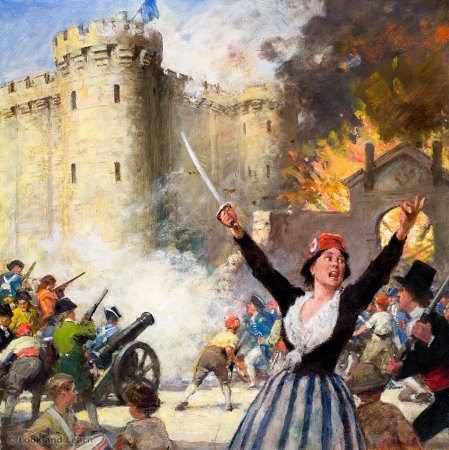
Another year, another Bastille Day in the (fifth) French Republic. I hope no one gets the wrong impression from my somber attitude on 14 July. The Principality of Monaco and the French Republic are good friends these days, everyone gets along and no one wants any unpleasantness. Many people also have the attitude that there’s no such thing as a bad time to have a party. However, I cannot condone such festivities on a day like this. Aside from all the horror the Revolution visited on France itself, the chain of events that started with the storming of the Bastille did no good for anyone in Monaco either, least of all the House of Grimaldi. There is no need to go into all of that in detail, we have covered it all before; the Grimaldis being stripped of their French titles, Prince Honore III being deposed, Monaco annexed to France, many going to prison (even the little future Sovereign Prince Florestan) and most horribly the wife of Prince Joseph of Monaco being among the last to be sent to the guillotine. But, in France itself, it is worth remembering on a day like today just how little most people know about the actual facts surrounding the storming of the Bastille and the start of the French Revolution.

The Kingdom of France was, undoubtedly, at a low point at the time. The economy was in shambles, hunger and poverty were widespread, too many in the aristocracy were living lives of indulgence far away from the people they should have been looking after and many in the clergy were more concerned with their own comfort than with administering the sacraments and teaching their people. However, the two young people at the pinnacle of power in France, His Most Christian Majesty King Louis XVI and Queen Marie Antoinette, were not blind or uncaring to these problems. Both had each been working in their own way to solve the immense problems they had so recently inherited. King Louis XVI enacted many common sense policies to alleviate the suffering of his people. He cut expenses at Versailles, cut government expenditures overall, refused to go deeper into debt and refused to raise taxes. He ended the government monopoly on grain which allowed for lower prices that more people could afford. He taxed wealthy landowners for the first time and, though he was not required to, paid his own share as any other landowner would. Likewise, Queen Marie Antoinette helped to educate poor children, had her own kitchen opened to the poor, cut down on lavish parties (yes, despite all you’ve probably heard) and simplified her own wardrobe in an effort to make frugality chic.


Unfortunately, the accumulated problems of decades could not be overcome quickly and the radical firebrands were doing everything possible to mislead, misinform and radicalize the public while spreading the most vicious lies they could think up about their King and Queen. For example, partly in an effort to pay for the war against Great Britain on behalf of the United States, King Louis XVI enacted a tax reform which raised revenues but lowered taxes for the poor. Revolutionary propagandists played their game of misinformation, only telling people that the King would be collecting more money (not less from the poor) and implying or stating outright that this was all for his own enrichment rather than paying for the needs of the country. King Louis had done everything in his power to be reasonable and accommodating. Early in his reign he had encouraged local parliaments and he recalled the Estates-General. However, the firebrands only increased their agitation, whipping the mob into a frenzy and blaming the King for ills he had absolutely no control over. Finally, someone pointed to the prison-fortress of the Bastille as the imposing symbol of absolute royal power that had to be wiped out.

On July 14, 1789 a Parisian mob stormed the Bastille, which was actually nothing like what they had been told or what most people today think it was. Naturally, it looked very harsh and foreboding from the outside, but inside the prison conditions were not terrible, certainly no worse than any other prison of the time and probably better than most. The fact was that there was practically no one in the Bastille. The popular portrayal would have one believe that the Bastille was crowded with the poor, tortured victims of an autocratic monarch. In fact, it was almost empty of prisoners. The only people present to be liberated were four forgers, two lunatics and a pervert who had been locked up at the request of his own family. The real victims were the unfortunate men who just happened to be doing their job guarding the prison. All 120 soldiers were brutally massacred by the hatchet-wielding mob and the governor had his head cut off and stuck on a pike. This was the bloody and inglorious start of the horrific bloodbath known as the French Revolution.

Monaco was, of course, much more fortunate than France. Most of the family survived, Monaco was ultimately given back her independence and the Sovereign Prince was restored to his rightful throne. The French monarchy was restored as well but, sadly, the Revolution had done too much damage in France. The mentality of the country had changed and the moral core of the country would never be quite the same again. The traditional monarchy would fall, replaced by another Kingdom of France that tried to reach an accomodation with the revolutionary mindset only to be undone in 1848 and all of this in between the two efforts at empire led by the famous Napoleon and his later nephew. It says something profound that, despite some minor problems, the Principality of Monaco in all that time has continued on in peace and ever-increasing prosperity, secure in the traditions of a centuries old monarchy led by a family everyone knows and loves while France had more revolutions, the Paris Commune and is currently on their fifth effort at a republic. Monaco has long depended on the protection of France but these facts, perhaps, suggest that France might benefit from taking a lesson from the little principality on her southern coast.

Vive le Roi!

Monday, June 18, 2012

King of Italy, Overlord of Monaco?


Royal titles can, at times, be a confusing subject, obscure to most but representing a great deal of fascinating history. For example, how many people are aware that among the titles of HM King Juan Carlos I of Spain are Duke of Milan, Count of Flanders and kingship over Gibraltar and even the "Ocean Sea"? Among the titles of HM Queen Beatrix of The Netherlands are those of Viscount of Antwerp (in Belgium), Lord of Montfort (in France) and Lord of Daasburg (in Germany). Likewise, back in the days when there still was one, the King of Italy had a long and illustrious list of titles which included the kingship of Sardinia, Cyprus, Jerusalem and Armenia but, interestingly enough, also the rather unique titles of "Overlord of Monaco, Roquebrune and 11/12 of Menton". In my own experience it seems quite unusual for a royal title to include fractions!

This, of course, was an historical 'leftover' from the Congress of Vienna following the downfall of Napoleonic France. The House of Savoy, at that time the Kings of Piedmont-Sardinia, replaced the French as protectors or, in the old feudal language, Overlords of Monaco which, at that time, included considerably more territory than the modern principality we know today. So, the Kings of Piedmont-Sardinia (who after 1861 became the Kings of Italy) were the overlords of Monaco. At least according to them. Actually, by the time the House of Savoy gained the Italian crown the French were back being the protectors of Monaco as well as by that time having gained Savoy, Nice and surrounding areas from Piedmont-Sardinia in exchange for supporting their struggle against Austria. King Vittorio Emanuele I of Piedmont-Sardinia was the first to gain the overlordship of Monaco, which was then passed to his successor King Carlo Felice and then to King Carlo Alberto and finally to King Vittorio Emanuele II who later became the first King of Italy.

King Carlo Alberto had at first hoped to bring Roquebrune and Menton into his own kingdom and sent troops into these towns during the uproar of the reign of HSH Prince Florestan. As we know, Prince Florestan did have a very monarchial temperment but his son, Prince Charles III, came to a new agreement with the French Emperor Napoleon III. After the 1848 Revolutions, Menton and Roquebrune took up the Italian tricolor and were officially placed under the direct protection of the Piedmontese monarch. That is where the fractions come in. However, King Carlo Alberto met with defeat in his fight with the Austrians and it was his son King Vittorio Emanuele II who himself came to an agreement with Napoleon III, giving up Nice and Savoy in exchange for French friendship and these areas have remained a part of France ever since. Grimaldi rule over Menton and Roquebrune was sold to France, which had the area already anyway, and that is when Monaco took on the shape we know it today, reducing the size of the principality considerably.

Control of areas come and go but titles are rarely changed, even if they are only a reminder of historic glories. The Princes of Monaco, likewise, still have many titles left over from their former place in the aristocracy of the Kingdom of France. Anyway, that is the background of why the Kings of Italy were, on paper at least, still titled Overlord of Monaco, Roquebrune and 11/12 of Menton.

Monday, April 30, 2012

The Marquis de Puyguilhem

Antoine Nompar de Caumont, marquis de Puyguilhem and (after 1692) the duc de Lauzun came from a noble French family but grew up mostly with the family of Antoine III de Gramont, a relative of his. If that name sounds familiar, it should; he was the father of Catherine-Charlotte de Gramont who later married HSH Prince Louis I of Monaco. The two shared a great deal of personal history. Long before she was promised to the Grimaldi heir, the beautiful young Charlotte de Gramont was, at the age of twenty, first in love with Antoine Puyguilhem. He was six years older than Charlotte, skinny, blond headed with a witty tongue, a malicious nature and a lust for wealth, women and lofty titles. Puyguilhem was just as passionately infatuated with Charlotte as she was with him, which is not at all surprising given the qualities she possessed. One observer remarked on her captivating beauty that she was, "a creature made for love and sensuality". When her father, Marshal of France de Gramont, informed his daughter that she was to be married, she hoped it would be to Puyguilhem. He was of lofty rank after all and was captain of the King's Household Cavalry. But the old Marshal could not stand the marquis, who could be rather unpleasant and who was rather impoverished for a nobleman.

As we know, her father's choice was Louis de Monaco, duc de Valentinois. Charlotte was less than pleased. Those closest to her witnessed her depression and remarked that, "The reason was that someone else pleased her more". Referring, of course, to Puyguilhem. The marquis remained attached to her, even after her wedding and kept on eye on her while the newlyweds were in Paris. He suspected that, married or not, she would come back to him eventually. However, when Charlotte, six months pregnant at the time, returned to Monaco to be with her husband, Puyguilhem became alarmed that he might be losing her. In a comic turn of events he followed Charlotte to Monaco (or at least to Toulon where Louis and Charlotte took a French galley for the last leg of their journey), dressing up in various costumes to try to disguise himself so her servants would not recognize him but he was never able to approach her. His cause seemed lost.

Then, in 1665 Charlotte, by then Princess of Monaco, returned to Paris and the fashionable society she always most enjoyed. Once again, Puyguilhem thought he would have his conquest. Yet, once again, there was interference but this time from none other than His Most Christian Majesty King Louis XIV of France and Navarre. The King had started to cast his ever-wandering eye in the direction of the Princess of Monaco and Puyguilhem was sensitive to the competition. He was still a regular at court, seen at every lavish dance and still winning criticism from those around him. Court chronicler Saint-Simon said he was, "ambitious, capricious, fanciful, insanely jealous, always going too far, never content with anything, without education, conversation or wit, by nature peevish, solitary and withdrawn, haughty in his demeanor, innately spiteful and sly". So it seems like Saint-Simon was not a big fan.

As King Louis XIV moved closer and closer to Princess Catherine-Charlotte of Monaco, Puyguilhem grew more and more jealous, finally losing his temper and throwing a minor tantrum in front of the King. The "Grand Monarch" was not impressed and ordered the marquis to return to his regiment of dragoons but Puyguilhem pretended that he didn't hear the King and stormed out, stomping in to Charlotte's apartments and threw such a fit he smashed one of her mirrors. Not a smart move to say the least. When he returned to his own quarters he found the King had left him a little note informing him that he would be provided with new accomodations -in the Bastille. After six months of fuming he was released and finally seemed to have given up on Princess Charlotte. Not long after he tried, without success, to seduce a daughter of King Carlos III of Spain. It seems amazing that a man so many described as "ugly" attracted so many women. The Grande Mademoiselle, Anne Duchess of Montpensier (King Louis' cousin) threw herself at him and Puyguilhem decided not to resist.

His affairs and intrigues continues to cause him trouble at the French court (leading to another stay in the Bastille for a time) before he moved to England to enter the employ of King James II. When the Stuart monarch, the last Catholic King of Great Britain, was about to be forced into exile, it was Puyguilhem who escorted James' lovely Italian Queen, Mary of Modena, and their son to safety in France. He also participated in the attempted restoration of James II in Ireland where, despite his much talked-about ill qualities, was known as the most honest in the King's circle of advisors. The failure of the expedition meant that he would never be restored to favor at the court of Louis XIV but Queen Mary of Modena was grateful enough for his support of the Jacobite cause that she used her influence to help secure his title of Duc de Lauzun. He died in 1723, leaving no heirs despite his marriage to a 14-year old girl (Genevieve de Durfort) in 1695.

Thursday, October 6, 2011

Matchmaker for Monaco Mazarin

Catherine-Charlotte de Gramont, one of the most famous and controversial Princesses of Monaco, is someone regular readers will be familiar with. Her thwarted love affair with her cousin the Duc de Lauzun, her involvement in the Orleans-Stuart love triangle and her stint as one of the many mistresses of King Louis XIV. But, how did this young woman who came so highly recommended, become the wife of HSH Prince Louis I of Monaco? The man responsible was one of the giant figures of French history (though like a few others he was Italian) we know as His Eminence Jules Cardinal Mazarin, the power-behind-the-throne for the very young King Louis XIV. He was born in Pescina in what was then the Kingdom of Naples but grew up in Papal Rome. His father worked for the powerful Colonna family (which everyone has heard of) which allowed him to gain a good education after which he served in the military and became a diplomat for the Papal States. He was later named nuncio to the court of France and was taken under the wing of the famous and powerful Cardinal Richelieu, the power-behind-the-throne under King Louis XIII.

When Louis XIV became nominal King of France with his mother, Ann of Austria, acting as regent, she relied heavily on Mazarin (by then a cardinal) and he became effectively the “prime minister” of the Kingdom of France. Catherine-Charlotte de Gramont was very well known to him. She had practically grown up with his nieces (known as the ‘mazarinettes’), she herself was a great-niece on her mother’s side and her father was a very prestigious person, Marshal of France, duc et pair, sovereign prince of Bidache, viceroy of Navarre and Béarn and governor of Pau. You could say he was somebody. So, when HSH Prince Honore II of Monaco came searching for a suitable bride for his young son Louis, he was referred to Cardinal Mazarin (who liked Honore II as both spoke Italian) and it was the Cardinal who said that Catherine-Charlotte de Gramont would be the ideal choice. Unlike Louis, she knew the French court and high society intimately. She could help him establish himself within the French aristocracy and the marriage would ensure continued Franco-Monégasque friendship. She was a few years older than the Grimaldi prince but devastatingly gorgeous, well connected and from a proper family so Honore II was quick to agree. Louis really had no say in the matter. For her part, from the start, Catherine-Charlotte was extremely disappointed, famously saying that her husband was, “not at all in fashion”.

Marshal Gramont agreed to pay a dowry of 300,000 livres for his daughter’s hand but, when he came up short, Cardinal Mazarin floated him a loan to keep his agreement (Honore II had to agree to make Louis Duc de Valentinois). However, the Cardinal was also responsible for the delay in actually having the wedding as he was focused on securing peace with Spain by seeing to the marriage of King Louis and the Spanish Infanta Maria Teresa. As we know, Prince Louis caught up with the King, the Cardinal and his bride-to-be in the Pyrenees (which was Gramont turf) and it was there that the couple first met. The old Marshal of France reported to Cardinal Mazarin that the ladies all loved Louis and that he was pleasantly surprised by him. He neglected to mention how down on the match his daughter was.

When the wedding of Catherine-Charlotte de Gramont and the Duc de Valentinois was held at the Gramont château of Pau it was a very lavish and ostentatious affair. Cardinal Mazarin did his part by sending the bride a shockingly beautiful jewel-encrusted crown to wear on the big day which guests said truly made her look like a queen. Cardinal Mazarin had arranged an historic match but it was not a totally happy one. The Cardinal continued his long and eventful career, advancing France by thwarting Hapsburg Austria, angering the nobles and squabbling with his fellow Churchmen until his death in 1661. King Louis XIV had by then taken control of affairs himself and would be one of the most famous absolute monarchs in history.

Sunday, March 6, 2011

Louis I and Louis XIV

Few Princes of Monaco and Kings of France have been as close as Prince Louis I of Monaco and the “Grand Monarch” King Louis XIV of France. It had been only recently that Prince Honore II had taken Monaco out of the Spanish sphere of influence and into the orbit of King Louis XIII of France and he was very anxious for close and friendly ties between the two countries. When Prince Louis was born in 1642 to then Hereditary Prince Hercule (son of Honore II) King Louis XIV of France stood as his godfather and the little prince was named in his honor. As he grew up, the goals of his grandfather could not have been lost on him. The court of King Louis XIV was the most grand and glamorous in the world and the highest possible place in that court was to be aspired to. Louis XIV and his Kingdom of France set the example to follow and as the protecting power of Monaco the House of Grimaldi had every reason to be the best possible friends to the “Grand Monarch” and his kingdom. Prince Louis I would be somebody at the court of Louis XIV, he would gain fame fighting in his armies, he would make the Princely Palace follow the fashions of Versailles and do his best to surpass all others who sought to bask in the glow of the “Sun King”.

It was ensured that Prince Louis, best known as the Duc de Valentinois before his accession, married someone well placed at the court of the French king and that choice was, of course, the famous Charlotte-Catherine de Gramont, daughter of the Marshal of France Antoine de Gramont and Marguerite Duplessis de Chivre, a great niece of Cardinal Richelieu. She undoubtedly helped her husband remain in the favor of the French monarch if only because he himself was so smitten by the young beauty and for a time she joined the ranks of the many mistresses of Louis XIV. Prince Louis fought in the armies of Louis XIV in his wars against England and Spain, gaining the approval of the King but few others at court where he was secretly made fun of for his ‘provincial’ ways, wearing the wrong clothes, wigs and such terribly important things. It was, however, the dramatic love life of Princess Charlotte-Catherine that was to prove the ruin of Grimaldi aspirations at Versailles. Before her arranged marriage to Louis I of Monaco she had been ardently pursued by the Duc de Lauzun -who never relented, even after she went to Monaco to give birth to the future Prince Antoine.

After that mission was accomplished the Princely couple returned to Versailles where King Louis cast his covetous eye on the wife of his godson. The Princess was more than willing to accommodate the King (finding the role of primary mistress to the King of France more attractive than being Princess of Monaco) but a jealousy-enraged Lauzun thwarted their rendezvous and King Louis was left frustrated, furious and rather embarrassed. The Princess of Monaco never looked good to him again (he possibly assumed she had been responsible for locking him out whereas Lauzun had actually made off with the key) and her chances of becoming the King’s official mistress evaporated. One can only feel sorry for Prince Louis I. He and particularly his grandfather had fought for the King of France, worked for the King of France and did all possible to gain his good graces ever since abandoning Spain for France in pursuit of the title of prince étranger at court. Louis XIV had promised to give it, yet, because of his wife’s jealous beau, through no fault of his own, Prince Louis I was denied this ultimate prize for another twenty years when his son, Antoine Duc de Valintinois, married Marie of the Imperial House of Lorraine in 1688, a match King Louis XIV himself arranged.

When the marriage of Prince Louis and Charlotte-Catherine broke down she left her husband in Monaco and retreated to Paris where Louis XIV was at least friendly enough to join her in laughing at the jealously and ‘provincial’ temperament of her husband. However, the business between the two monarchs named Louis was not quite done. To the surprise of many, during all of the tumult over the Spanish succession, Louis XIV named the Prince of Monaco his ambassador to Rome. The elites at court may have made light of Prince Louis I but his devotion could not be questioned, he had fought for France on numerous fields of battle, and it was hoped that his Grimaldi family connections in Italy would give him a stronger position than some other ambassador might have had. Prince Louis took up his position with zeal and so did his utmost to woo and influence the Roman aristocracy and clergy that he all but bankrupted Monaco in the process. However, it was in no small part due to his efforts that Louis XIV won his case at the Vatican which saw his grandson ascend the Spanish throne as King Philip V.

Still, the pair could not finally end on a completely high note. After the death of Pope Innocent XII, Prince Louis had campaigned for the election of his successor Pope Clement XI. Nonetheless, the new Pontiff did not favor the Prince of Monaco who went to Paris to complain to King Louis. Some accounts say that the “Sun King” embraced the Prince, rebuking him, “only for his zeal” while others say he snubbed him completely before ordering him back to Rome. Whatever the actual situation, this last drama seemed to take something out of Louis I who died in 1701 at the age of almost 58. The King would continue until 1715 as the quintessential absolute monarch and the dominant figure of his age. It would be difficult to overstate the importance of Louis XIV. He did not succeed in all of his goals as King of France, yet throughout his entire reign he was the sun around which all else revolved. Practically everything that was done in western Europe at that time was a reaction by the other powers to the actions of Louis XIV and, even if he had not totally triumphed, he did survive -which was quite an accomplishment. For his godson and namesake, Monaco remembers Louis I mostly for his legal code and his rather colorful private life, a significant figure to be sure in the story of the Principality. At the time, however, godson or not, he was one more star in the firmament dominated by the “Sun King” as far as Louis XIV was concerned. Still, he had at least fulfilled all of those tasks entrusted to him and he had finally achieved that long sought after goal for his family; that of a prince étranger at the court of Versailles, which was, for that time and place, as good as the center of the world.

Wednesday, February 16, 2011

The French Royal Martyrs and Monaco

Since starting this weblog, and preferring to talk about the history of the Grimaldis and Monaco more than current goings-on (though that isn’t always possible) I have often been asked about the relationship between the ill-fated French royals King Louis XVI and Queen Marie Antoinette and the Principality of Monaco. I have been hesitant in addressing this subject for a number of reasons but wanted to for others. In the first place, there is not much to tell. The short answer is that Louis XVI and Marie Antoinette had practically nothing to do with Monaco or the Grimaldis aside from the occasional social meeting. I also do not like making comparisons between royals that highlight the shortcomings of one side or another and yet I also did want to at least address this subject because I am a great admirer of the martyred French king and queen and would like to point out how unfair the popular portrayal of the couple remains. Unfortunately, that cannot really be done without reliving some of the unfortunate shortcomings of my dear Grimaldis. Be that as it may, let’s dive in.

Politically of course, the King of France and the Prince of Monaco were very close. The political situation was pretty much the same then as it is today. Monaco was, and still is, an independent protectorate of France. The Prince of Monaco, at the time Honore III, was a sovereign monarch but King Louis XVI of France was responsible for the protection of Monaco. However, the Grimaldis were much more important in France in the time of Louis XVI than they are now since the Princes of Monaco held lands and titles in the French aristocracy and so had a high place in the French court so, naturally, there were meetings between the two at Versailles and so on. However, Honore III was about 34 years older than Louis XVI so it would not be expected that they would be buddies or anything or even nearly as close as say Honore II and Louis XIII or Louis I and Louis XIV had been. However, even with the Hereditary Prince Honore IV, he and his wife, Princess Louise, Duchess de Mazarin, did not have much in common with Louis XVI and Queen Marie Antoinette.

The French King and Queen never visited Monaco, they rarely traveled at all and even the Princes of Monaco at that time were seldom in Monaco themselves. Prince Honore IV is something of a mysterious figure, only slightly younger than Louis XVI, since before the Revolution he was so overshadowed by his over-the-top wife and afterwards by his brother Prince Joseph who managed family affairs because Prince Honore IV was frequently ill. The marriage of Honore IV and Louise de Aumont Mazarin had been arranged and the two were completely incompatible with Princess Louise grabbing the most attention. As far as wives go, no two women were more opposite than Princess Louise and Queen Marie Antoinette. Not many people realize this because of the inaccurate portrayal of the French Queen but, as a matter of fact, the Hereditary Princess of Monaco was much closer to the way Marie Antoinette is so often accused of being.

No matter if one dismisses the most lurid tales as nothing more than court gossip there is no denying the fact that Princess Louise was a woman of rather loose morals who loved nothing more than wild and lavish parties with the most inventive costumes and diversions. Marie Antoinette is often portrayed this way but the truth is the total opposite. The King and Queen were both very religious people whereas the Grimaldis, although staunch Catholics of course, were not the most devout people in the world and Princess Louise certainly was not. Queen Marie Antoinette purposely did not associate with her because she so disapproved of her lifestyle, attitude and even her appearance. Whereas Marie Antoinette had a more delicate, childlike sort of beauty, Princess Louise was very voluptuous and bold and that type. So, Queen Marie Antoinette avoided Princess Louise specifically for behaving in ways that the Queen herself is so often accused of. It serves to illustrate how terribly unfair the popular portrayal of Marie Antoinette has been.

Prince Honore IV was nothing like his wife, which is one reason why they did not remain married for long, effectively parting before the revolution and divorcing during the period of the directory but even that was something the pious French King and Queen would not have approved of and could not have related to. In short, the two couples simply moved in different circles despite their proximity at the royal court in Versailles. And, even though Princess Louise in many ways embodied the sort of lifestyle Marie Antoinette was accused of being guilty of, the former Princess of Monaco would survive the revolution while the tragic Queen of course did not. Princess Louise, Duchess de Mazarin, with her husband Prince Honore IV and others of their family, were arrested by the revolutionaries but she managed to escape with her son, Prince Florestan, thanks to the kindly intervention of a doctor who was a family friend of the Grimaldis.

So, the House of Grimaldi ended up better off than their French counterparts, at least in as much as most of the Grimaldis survived the revolutionary bloodbath. They were eventually restored to their throne, as were the Bourbons, but the Grimaldis managed to stay whereas the French monarchy sadly did not. The families were close in political terms, friendly and correct and they both suffered due to the revolution. However, personally, they simply were not that close because they did not have a great deal in common and generally moved in different circles. Past kings had been much closer to the princes of Monaco but Louis XVI was quite different from his predecessors and neither he nor Honore IV were very “social” types. Their wives, contrary to popular belief, were as opposite as night and day. The Queen disapproved of the Princess of Monaco and the princess probably would have viewed the Queen as rather boring and prudish. For those who view Marie Antoinette as a consort unconcerned with her adopted country, unattached to her husband and given to extravagant spending and lavish parties they are actually giving an unfortunately accurate description of Princess Louise whom the Queen of France made it a point to avoid for those very qualities.

Friday, January 21, 2011

The Death of a King

It was on this day in 1793 that His Most Christian Majesty, King Louis XVI of France and Navarre was executed guillotine after being declared a "traitor" by the French Convention. As had been the case since the reign of King Louis XIII, the King of France was the official protector of the Principality of Monaco and feudal overlord of her princes. Now the Bourbon monarchy had been abolished and Louis XVI was sent to his death for his royal blood. In time his wife would follow him, also sent to the guillotine, and his little son and heir, the Dauphin, would be starved to death in a revolutionary prison. This news undoubtedly sent shock waves throughout the House of Grimaldi. If the French revolutionaries would kill their own king, whose person was once held sacred, what mercy could a deposed monarch of a foreign princely family expect? At the time, HSH Prince Honore III was himself in a revolutionary prison, his country had been torn from him and in due time would be absorbed completely by the French Republic. What horror Prince Honore III and his son Hereditary Prince Honore IV must have felt when this news reached their ears. No doubt they wondered when their own turn to face Madame Guiolltine would come. Thankfully, that day did not come save for the tragic Princess Francoise-Therese de Choiseul-Satinville, wife of Prince Joseph of Monaco.

Although they may not have felt it as severely as the Princes of Monaco sitting in prison in Paris, the whole world was shocked the regicide of Louis XVI and none moreso than the remaining crowned heads of Europe. However, the United States was also not without outrage on the occasion. It had, oddly enough, been Thomas Paine of Pennsylvania, the famous propagandist of the American Revolution who had really sold the American public on dropping their loyalty to the King of England, who was the single member of the Convention to vote against the execution of the King. Paine warned his fellow revolutionaries that America had not forgotten that it had been the intervention of King Louis XVI which had ensured their victory in the war for independence. As Paine said, 'The man you have condemned to death is regarded by the people of the United States as their best friend, the founder of their freedom'. He warned them that by killing King Louis they would instantly turn the United States from a friend to a foe of the Revolution. Although some supporters remained, by and large he was correct.

Saturday, January 8, 2011

Louis Joseph, Prince de Condé

Louis Joseph, Prince de Condé, had more than a few connections with the Grimaldi Princely Family during the tumultuous period of the French Revolution which saw the Kingdom of France destroyed and the Principality of Monaco annexed to the French Republic. He was born Louis Joseph de Bourbon on August 9, 1736 to Louis Henri Duc d’Bourbon and Landgravine Caroline of Hesse-Rotenburg. As a prince of the blood he was a member of the very highest echelon of French society. His grandmother, in fact, was the daughter of King Louis XIV by his famous mistress Madame de Montespan. His father died in 1740 and his mother the following year and Louis Joseph was raised by his uncle the Comte d’Clermont. By his mother he was related to the House of Savoy and to a whole horde of French royals and aristocrats on the side of his father. On May 3, 1753 he married Charlotte Elisabeth Godefride de Rohan, granddaughter of the Duc d’Bouillon at Versailles.

Soon the father of three (though one daughter did not long survive) the Prince de Condé busied himself with building projects, attending court and overseeing the upbringing and beneficial marriages of his children. His was a very familiar face at the courts of King Louis XV and King Louis XVI as well where he held the rank of Grand Maître de France in the King’s household. The military was also a long established duty and the Prince de Condé saw action in the Seven Years’ War (known in America as the French and Indian War) and rose to the rank of general, also serving for a time as Governor of Burgundy. However, life in France was soon to take a very dark turn with the growing discontent that eventually led to the outbreak of the French Revolution. Up to this point there was not much of a connection between the Prince de Condé and the House of Grimaldi. They would have met at court where the Prince of Monaco was well known and since the Princes of Monaco were also members of the French aristocracy. The Revolution, however, would bring the Grimaldi and the Condé together.

Sensing the trouble to come, when the Paris mob stormed the Bastille in 1789 the Prince de Condé went into exile, saving himself from what would surely have been certain death in the Reign of Terror that followed. To be a Bourbon in France at the height of the terror was almost as good as a death sentence. The King, the Queen and even the Duc d’Orleans were executed in 1793. That same year Prince Honore III of Monaco was deposed and later arrested, his country annexed to the French Republic and renamed Fort Hercules. His son and heir, Honore IV, was arrested in Paris with his father, but his second son, Prince Joseph of Monaco had fled with his wife into exile. While in exile Prince Joseph of Monaco made common cause with Prince Louis Joseph de Condé who was organizing a royalist army at Coblenz in 1791, made up mostly of French exiles, with the aim of returning to France to liberate their country from the forces of the revolution and the rule of Madame Guillotine.

The Army of Condé, as it came to be called, included a long list of famous names from the French aristocracy and Royal Family. Aside from the Prince de Condé and Prince Joseph of Monaco there was the Duc d’Enghien (grandson of the Prince de Condé), the Comte d’Artois (brother of the late King Louis XVI), the Duc d’Richelieu, the Duc d’Blacas and Chateaubriand and so on. Originally they fought alongside the imperial forces of Austria until squabbling between the two forces compelled the Prince de Condé to transfer his men to the British jurisdiction in 1795. However, that year was to see the last of Prince Joseph in the ranks, though his presence had already cost him dearly. Word that he had joined the counter-revolutionary forces of the Prince de Condé reached Paris and when his wife returned to France to see about their children she was discovered, arrested and sent to the guillotine in 1794. She was the last victim of the terror and the more moderate forces that took charge after allowed Prince Joseph to return to France to take charge of family affairs after the death of his father.

The Prince de Condé, however, continued onward with his mission, fighting in Swabia in 1796 before being forced to transfer to Poland and join with the Imperial Russian Army when Austria made peace with the republic in 1797. When Russia left the allied camp in 1800 the Prince returned his forces to the British camp, undoubtedly not an easy thing to do for a man who was a veteran of the Seven Years’ War. The Prince and his army fought in Bavaria but was disbanded in 1801 without ever seeing their dream of the liberation of France and the restoration of the monarchy come to fruition. The Prince de Condé went into exile in England where he lived with his second wife, none other than Marie Catherine de Brignole-Sale, the ex-wife of Prince Honore III of Monaco, whom he had married in 1798. In fact, it was the Prince de Condé, already the smitten kitten, who had helped obtain the final break between the then Princess of Monaco and her husband while she had taken refuge in a convent following after Honore III had been driven to fury by the affair his wife had been having with the Prince de Condé in Paris.

In any event, the former Princess of Monaco spent herself into poverty supporting French royalists and their cause, which was also the cause of her husband, until her death in 1813, so much so in fact that the British Royal Family had to step in to help with the funeral expenses. When Napoleon Bonaparte was finally defeated the Prince de Condé was able to return to Paris and take up his place again in the French court after the restoration of King Louis XVIII. He died in 1818 leaving two children; his son who succeeded to his title and his daughter who had taken vows and risen to become abbess of Remiremont Abbey. He was buried in St Denis Basilica.

Saturday, December 11, 2010

Princess of Monaco at Versailles

The Grimaldis were once a common feature of the court at Versailles. Princes of Monaco, in their capacity as the Dukes of Valentinois, along with their significant others, joined the ranks of the nobility of France basking in the glow of the "Sun King" Louis XIV. Alas, with the French Revolution it seemed those days were gone forever -and so far they have been. Yet, last Monday the magnificent palace at Versailles was again graced by the presence of a Grimaldi in the person of Her Royal Highness Princess Caroline. In her capacity as president and founder of the World Association of Children's Friends (AMADE) Princess Caroline attended the 18th La Nuit Internationale de l’Enfance (International Night of Childhood) charity gala. It was only fitting that the Princess chose this venue to help raise money for children in need as it is a cause close to her heart and caring for children (particularly orphans) is one of the primary goals of Princess Caroline's charity AMADE which she is so devoted to.

In all there were about 700 guests at the event, organized by Anne-Atmone Giscard d'Estaing, former First Lady of the French Republic, who is also president of the Foundation for Children. There cocktails in the stone gallery followed by a tour of the royal apartments and the Hall of Mirrors. For those of us who are history fans it is impossible not to imagine Princess Caroline walking through the same rooms and hallways that famous ancestors of hers, such as Princess Catherine-Charlotte de Gramont, Prince Louis I, Prince Antoine I and Princess Marie de Lorraine also walked through, lived in and carried out their own dramas around the King of France. After the tour there was entertainment at the Versailles opera house by Arielle Dombasle. A good event for a good cause but, aside from the presence of Princess Caroline, how many people around the world would have ever heard of it? The glitter and glamour of this events would be so much greater, and thus so much more effective in their benevolent goals, if Princess Caroline, who would also have her own place in the French nobility as the granddaughter of the Duc d'Polignac, was the rule and not the exception and if, instead of a former First Lady, the gala was organized by the Queen of France.

Wednesday, July 14, 2010

Bastille Day

Today the republicans of France celebrate the storming of the Bastille, usually used as a way to mark the start of the French Revolution. The "accepted" viewpoint is that the Bastille represented tyranny and oppression and the storming of the Bastille and the subsequent revolt was a glorious uprising of the people for 'liberty, equality and brotherhood'. However, facts can often get in the way of a good, rabble rousing story. The fact is that the Bastille was ugly and imposing but was not a terrible prison. At the time of the storming it held only a few petty criminals and lunatics. Moreoever, the Revolution that followed did not deliver freedom and liberty but a horrific bloodbath, known even at the time as the "Reign of Terror" which was not finally ended until the imposition of the authoritarian regime of Napoleon. It was not a battle between suffering masses and a cruel elite, in fact it was the poor common people who suffered the most and far more of them were murdered than were aristocrats. It was a terrible turn of events that brought greater suffering than anyone in Europe at that time had ever seen.

The storming of the Bastille also set events into motion that led to misery and suffering for France's neighbor Monaco. Shortly after the Bastille fell the revolutionary instigators infiltrated the lands of the Prince of Monaco and encouraged uprisings and demands for government power in Monaco, Menton and Roquebrune. HSH Prince Honore III was caught in a desperate situation. He allowed the formation of independently elected councils in the towns of his domain to appease his subjects and then rushed to Paris to try to save his considerable estates as a member of the French nobility. On August 4, 1789 he lost everything with the adoption of the abolition of all feudal rights and privileges in France. Promises were made to compensate him as he was a foreign prince and the Grimaldis had been given their French titles as payment for services to France but nothing ever came from it. The Grimaldis and Monaco were pulled down into the abyss that was the French Revolution.

The Prince de Conde (whose paramour was Honore III's ex-wife) gathered the royalist emigres to fight for the Kingdom of France and Prince Joseph of Monaco (a veteran of the Lorraine Dragoons and the Royal-Cravate) joined them. On October 22, 1792 French revolutionary forces occupied Monaco which Honore III protested but could not stop and his petitions were ignored. A Monegasque branch of the Jacobin Club, a radical bloodthirsty society led by the notorious executioner Robespierre, was set up in Monaco and the palace was ransacked by a revolutionary mob. In January of the next year they finally got around to arranging a "vote" to depose Honore III and allow Monaco to be annexed to France. Relegated to a mere cantonal seat in the Alpes-Maritimes department the "People's Council" voted to change the name of Monaco to Fort d'Hercule.

These were the darkest days for the House of Grimaldi. Prince Honore III, old and soon to die, tried to get back simply his own personal property but even this was denied him. Prince Joseph went into exile and Honore III and his son Honore IV were thrown in prison by the revolutionary regime. Honore IV's ex-wife Louise-Felicite and their son Prince Florestan were also put in prison. All of the property of the Grimaldi and Mazarin families were confiscated and Princess Francoise-Therese, the beloved wife of Prince Joseph, went to the guillotine as the last victim of the Reign of Terror. Ironically it was on that very day, 9 Thermidor on the revolutionary calendar, that Robespierre himself, the instigator of the nightmarish bloodlust, was arrested by his own revolutionary cohorts. That would not be the end of the ordeal and anyone observing the situation could have understood the Grimaldis and the people of Monaco giving up. Thankfully, they did not and their fortunes were ultimately restored but the spiral downward, toward revolution, occupation, terror and death all started today, July 14, in 1789 with the storming of the Bastille.

Thursday, February 4, 2010

King Louis XIII of France

King Louis XIII of France occupies a special place in Monegasque history. Louis was born on September 27, 1601 to King Henri IV and Queen Marie de Medici and became King of France and Navarre in 1610. At this time the Principality of Monaco was within the sphere of influence of the Kingdom of Spain. However, the Monegasque monarch, HSH Prince Honore II, was planning to change that situation in the biggest political turnaround in the history of Monaco. His aim was to take Monaco from the Spanish camp to the French camp.

During the reign of King Louis XIII, thanks in large part to his cunning minister Cardinal Richelieu, the star of France was on the rise. This was a momentous time for such a decision as France and Spain were then on opposite sides of the Thirty Years War. Although usually generalized as a war between Catholics and Protestants things were not really that simple and Catholic France joined the Protestant side as a way to advance French power at the expense of their greatest continental rival the Catholic Hapsburgs of Austria.

Louis XIII saw the French nobility brought into line with the Crown, rescinded the privileges of the Protestant Huguenots (though their freedom of religion was maintained), modernized the ports and put France on the road to becoming a major naval power again. He also was a great patron of the arts and expanded French influence in North America. The framework was being laid for the unsurpassed greatness France was to achieve during the future reign of the “Sun King” Louis XIV. Prince Honore II of Monaco had already been going in a very French direction. He redecorated the Princely castle, making it more of the palace we know today, favoring French styles and even wearing his hair in the fashion of Louis XIII.

Everything had to be done in secret and Honore II succeeded so well in this that the Spanish never suspected a thing. On September 14, 1641 King Louis XIII signed the Treaty of Péronne which reestablished formal diplomatic relations between France and Monaco. Louis XIII wrote to Honore II saying, “I assure you that you will discover in me such sincere good will toward you and all your House that you will never come to regret the decision you made known to me”.

King Louis XIII recognized the sovereignty of Monaco and agreed to be the protector of the principality. He promised to send a garrison of 500 French troops which he would pay for but who would answer to the Prince of Monaco who would also be party to all future treaties signed by France. To make up for the estates in Italy the Spanish had granted to the Prince of Monaco Louis XIII promised to pay an annual pension of 75,000 livres from three French fiefdoms; a duchy, a marquisate and a comté. This was the foundation of the special relationship between France and Monaco that has endured, with few interruptions, to this very day.

Once Honore II pulled off his coup and subdued the Spanish garrison in Monaco he hurried to King Louis XIII who granted him several noble titles and decorated him with the Order of the Holy Spirit. As for King Louis XIII, he had some trouble producing an heir to the throne but when that day came he dedicated his kingdom to the Blessed Virgin Mary in thanks for her intercession. He died on May 14, 1643 leaving a stronger kingdom than the one he had inherited and with a foundation for further future greatness that would come during the long reign of his famous son.

Saturday, November 14, 2009

Charles Auguste de Matignon

Charles Auguste de Goyon de Matignon, Comte de Grace was the uncle of HSH Prince Jacques I of Monaco and one of the leading soldiers of France in his day. Born in 1647 he was the sixth son of Francois de Goyon, lord of Matignon and Anne de Malon of Bercy. He embarked on a military career at an early age and in 1669 took part in the campaign in Holland in which he distinguished himself and later served usefully in Flanders and Germany in 1684. When his brother Charles died in 1674 he was given the title of Comte d'Grace and in 1688 was made governor of the province of Aunis. In 1689 accompanied King James II of Great Britain and his Jacobites to Ireland where he commanded troops in the effort to restore James II to the throne that had been usurped by his son-in-law William of Orange. Of course, as well all know, the enterprise ended in defeat at the battle of the Boyne. One observer described him as a good and honest man but was less than impressed with his military abilities.

Matignon returned to France after the Jacobite defeat saw action at the sieges of Mons and Namur. In 1691 the King of France gave him the rank of brigadier general and in 1693 the rank of major general. In 1708 he was awarded the supreme military prize with the rank of Marshal of France with the name of Marshal of Mantignon. In 1715 he was dispatched with the nominal King James III of Great Britain (the Old Pretender) for another Jacobite uprising to restore the Stuarts to the British throne, however, this expedition gained even less traction than the first and was quickly suppressed by the government forces of the Hanoverian King George I. Marshal Matignon returned to France and served on the battlefield again in Flanders before his death in 1729 at the age of 83 having by that time also acquired the titles of Chevalier of Torigni and Baron of Bricquebec. In 1942 his portrait was featured on a 20+10 cent Monegasque stamp.
Related Posts Plugin for WordPress, Blogger...