Friday, July 30, 2010

Red Cross Ball 2010

The 62nd annual Red Cross Ball was held today at the Monte Carlo Sporting Club of the Principality of Monaco, the biggest event on the Grimaldi's social calendar and the largest charity gala in the world. The special guest entertainment this year was Tom Jones and the "theme" this year was a luxury cruise.

HSH Prince Albert II arrived with his two special girls. Fiance Charlene Wittstock set a glamorous tone that has drawn mostly praise from observers. HSH Princess Stephanie turned heads with her fashion choice -reviews have been mixed, though in my very biased opinion I think she looks fantastic.

Other celebrities on the guest list included model/actress Victoria Silvstedt (a regular every year), singer Julio Iglesias, the ever-present and ever-ominous looking designer Karl Lagerfeld, singer Shirley Bassey, Baroness Tita Cervera, Tiziana Rocca, Isabell Kristensen, etc. Also attending was Prince Albert's former paramour and mother of his son Alexandre, Nicole Valerie Coste. I hope Charlene was properly prepared for that experience. Although Nicole has attended events at which the Prince was presiding before this was the first time she ever attended a formal ball. Sadly, once again, Princess Caroline was not to be seen, nor were the "Casiraghi trio" who lately have attended more often than not. Still, it was a very glamorous and successful event, as it usually is, Charlene seemed to handle all the extra attention very well and it is always great to see Princess Stephanie at such formal family events.

Monaco Boys Choir Perform in New York City


See also this previous post on Church Music in Monaco

Monday, July 26, 2010

Pope Innocent IV

In the history of the Catholic Church one pontiff who, inadvertently, had a major impact on Monaco was Pope Innocent IV. Coincidentally enough he was a native of Genoa, born there as Sinibaldo Fieschi in 1195. He was educated in Parma and Bologna until being called to Rome to serve in the Curia in 1226. The Church had enjoyed a succession of strong popes, particularly Pope Innocent III during whose reign the Church reached its peak of political power in Europe. Lately, however, conflicts had arisen with the Holy Roman Emperor Frederick II (quite famous and formidable in his own right he was known as the ‘Wonder of the World’). After a very long and contentious conclave Cardinal Fieschi was elected, a decision he accepted with great reluctance. He had been on friendly terms with the Emperor but as pope he could have no favorites and Frederick II expected this and it surely turned heads when he took as his name Innocent IV.

Problems arose almost immediately over imperial control of the Church (such as in the appointment of bishops) and the earlier seizure of northern Italy from the papacy by the Emperor. Italians were roused to anger against the German monarch and open conflict seemed inevitable. In 1244 the Pope left Rome (where German agents made things dangerous for him) and moved to Genoa and from there he later went in disguise to France where he was warmly received in Lyons. Safe to act freely he summoned a council aimed at reminding the Emperor that his power had limits. On July 17, 1245 the Pope and assembled bishops formally excommunicated Frederick II and absolved his subjects of all allegiance to him. All across Europe there were preparations for war but, perhaps fortunately for the Pope, Frederick II died only five years later which ended the crisis for the moment and Innocent IV returned to Rome.

The Pope had numerous political as well as religious matters to deal with and, like the previous pontiff of his name, maintained that as the Pope was the Vicar of Christ he had final authority over all kings and princes. He intervened in Portugal, Austria but could be a strong ally to monarchs as well as an adversary, taking the side of King Henry III of England even when the nobles and bishops of the country were opposed to him. He even sent a mission to the Great Khan of the Mongol Empire, Guyuk Khan, grandson of Genghis Khan. He asked the Mongol Emperor to cease his attacks on Christian countries and advised him to become a Catholic. Guyuk kept his own religion and sent a message back demanding that the Pope and all the monarchs of Europe submit to the rule of the Great Khan. That submission was not forthcoming.
In his latter days Pope Innocent IV was again occupied by problems with the Holy Roman Empire, specifically the offspring of Frederick II who were still struggling for domination of Italy. He died in 1254 in Naples but the battle lines had already been drawn and across Italy, particularly northern Italy, factions emerged which supported the Pope (the Guelphs) and the Emperor (the Ghibellines). One of the places where this rivalry was fiercest was in the Pope’s native Genoa where both sides made war against each other in true vendetta fashion. The result was a Ghibelline victory and the expulsion of the Guelf families, one of which was the House of Grimaldi. Driven from their home they looked to take their revenge and seek their fortunes elsewhere and the target they had in mind was the Ghibelline fortress on the Rock known as Monaco.
So, if you have ever wondered why Pope Innocent IV was featured on a Monegasque postage stamp...now you know.

Saturday, July 24, 2010

The Date is Set

HSH Prince Albert II and Charlene Wittstock have officially set a date for their upcoming wedding. The happy event will start next year on July 8 with a civil ceremony, at the Princely Palace we presume, with a religious ceremony the following day, July 9, presumably at St Nicholas Cathedral. The staff at the palace are already very busy making the preparations for what will be the first such event held in the principality in decades. We can only hope that a proper balance will be struck to share the happy occasion with everyone while keeping it intimate and joyful for the happy couple as well. As many know the wedding of the late Princess Grace and Prince Rainier, while it looked very glamorous and so like a fairy tale from the outside, was not a very pleasant experience for the couple who, they revealed later, felt positively suffocated by all the cameras, photographers and general horde of media that descended on their little Mediterranean paradise. We can hope for things to be at least a little bit calmer this time around considering that Charlene does not have the same pre-marriage celebrity status that Princess Grace did as an international movie star and, perhaps, because Charlene is already a familiar face around Monaco having been part of their lives, as she has been part of that of the Sovereign Prince for some time now. In any event, we can only hope things go smoothly, the time will certainly fly by for those doing the planning and we can all look forward to a grand wedding in true Monegasque style which has long been wished for by many.

Thursday, July 22, 2010

Grimaldis in England

Last Saturday HSH Prince Albert II of Monaco and fiance Charlene Wittstock were in England taking in the Asprey World Class Cup at Hurtwood Park Polo Club in Ewhurst. As can be seen on the left in this photo, also on hand was Grimaldi cousin Melanie de Lusignan (probably there for promotional work) who, as readers will know, is the granddaughter of HSH Princess Antoinette of Monaco, the older sister of the late Prince Rainier III and currently the most senior member of the Grimaldi clan. No word if the Sovereign Prince got into any trouble for wearing his "La Martina" (an Argentinian polo team) cap to a match in England...

Tuesday, July 20, 2010

Bishop Augustin Grimaldi

Augustin Grimaldi was born in 1482, the son of Seigneur Lambert of Monaco and his wife the Lady Claudine. Lords Jean II and Lucien were his brothers and Augustin himself would one day rule Monaco as well, though he took a different path in life, becoming a priest and eventually rising to the positions of Bishop of Grasse and Abbot of Lérins. This was something of a family tradition as his uncle, Jean-André Grimaldi, had also been Bishop of Grasse and a diplomat on behalf of his brother Lord Lambert. Bishop Augustin would do much the same but with even greater success. He may be most remembered outside the country as the founder of the village of Valbonne in France, but in Monaco he is remembered as a national savior.

His first, most vital service, came during the Genoese invasion of Monaco in 1506-1507. While his brothers Lord Lucien and Charles were struggling to repel the Genoese Bishop Augustin of Grasse was dispatched by the brothers, along with their sister Francoise, to the court of King Louis XII of France to appeal for French assistance. Genoa had tried to keep the French out of it but King Louis had considerable interests in northern Italy and the last thing he wanted was a revived and more powerful Genoese republic. So, Bishop Augustin was successful and Louis XII dispatched the French Governor of Savona, Yves d’Allégre, with his troops to come to the aid of the Monegasque. In mid-March of 1507 the Genoese spotted the approaching French army and finally gave up their attack and retreated.

Bishop Augustin was left in charge of things in Monaco while Lord Lucien joined the French in pursuing the enemy, finally joining in a siege against Genoa led by King Louis XII himself. The French and Grimaldi forces were successful but in the aftermath Lucien was imprisoned by his ally after he refused to either sell Monaco to France or become the vassal of the French king. Bishop Augustin was still overseeing the cleanup of Monaco, which was in ruins after the Genoese attack, when he received a message from Louis XII demanding the surrender of Monaco. Naturally, the Bishop refused and the King promptly ordered his galleys to move against Monaco by sea and dispatched 4,000 troops to attack overland.

The situation could not have been more desperate. The small Monegasque army had been reduced to a skeletal force and the fortifications were in ruins because of the recent attack. There were hardly any soldiers, few supplies and almost no money. Bishop Augustin, in response, did the only thing he could do; he stalled. Using every diplomatic trick up his sleeve he kept the French out with a string of vague and contradictory messages. He weaved red tape like a master and in so doing saved Monaco from utter disaster. Bishop Augustin kept this going until the tide turned against the French in Italy and Louis XII was forced to release Lucien. Yet, in the years that followed, Holy Roman Emperor Charles V, King of Spain, defeated the French in Italy, captured Genoa and cast a long shadow over Monaco.

The next year, in 1523, Lord Lucien was assassinated in an attempted coup led by the Doria family. Bishop Augustin happened to be passing through on his way back from Cannes a short time after these events and so, according to the will of their mother Claudine, Bishop Augustin took charge of the government as regent in the name of his young nephew Honore I. Historians since have hailed Bishop Augustin as the most intelligent of the three brothers to rule Monaco and such an estimation seems believable. Already famous for his diplomatic skill, the Bishop proved a firm leader in the aftermath of the murder of his brother and, full of righteous indignation, he organized his forces to hunt down and punish those responsible.

Bishop Augustin was known, even at the time, as a remarkable man. Having lived in Rome he was well connected there, respected in the French court for his diplomatic talents, well known for his great intelligence and his piety, even going on a pilgrimage to Jerusalem some years before. He was 44 when he became regent of Monaco but, being a man of the cloth, he had to have the permission of the Pope to hold temporal power. Because he was so well known and admired by the curia in Rome this was quickly granted and he could carry on with the government of Monaco. His first order of business was to punish the murderer of his brother, namely Barthélemy Doria. Through some trickery he managed to capture him but when Pope Clement VII advised showing mercy Bishop Augustin released him.

Doria later died while serving in the French army and it had not escaped the notice of Bishop Augustin how little the French seemed bothered by the crisis that had shaken Monaco. The country was still in a very precarious situation and needed the protection of a great power. The two most powerful monarchs in the region were King Francois I of France and Emperor Charles V of Spain. Bishop Augustin would have to choose one or the other and Pope Clement VII advised him to choose the Emperor. Augustin sent a relative, Leonardo Grimaldi, to negotiate an alliance with the Holy Roman Emperor, the most powerful man in Europe at the time. Leonardo went too far in the first negotiations, sacrificing Monegasque independence, but Bishop Augustin was so persuasive in his appeal that Emperor Charles V annulled the agreement and in the Tordesillas declaration recognized the independence of Monaco.

Emperor Charles V visited Monaco during the regency of Bishop Augustin; a guest of some considerable significance. To some extent the decision to align with Spain was the correct one. Charles V defeated the King of France, obtained Spanish dominance over Italy and was even given the Iron Crown of Lombardy by Pope Clement VII. Yet, the Spanish presence proved burdensome and the treasury of Monaco was emptied paying for the garrison as promised compensation never arrived. Thus it was said that Bishop Augustin came to regret his decision to take Monaco into the Spanish sphere of influence at the end of his life. That end came on April 14, 1532, suddenly, which caused rumors of poisoning to spread but there is no evidence of that. Bishop Augustin had literally saved Monaco on more than one occasion and proved himself a masterful regent as well as a devout churchman. The alliance he arranged would last until 1641 when Prince Honore II ousted the Spanish and took Monaco back into the orbit of France where it has remained ever since.

Sunday, July 18, 2010

Princely Remnants in Menton


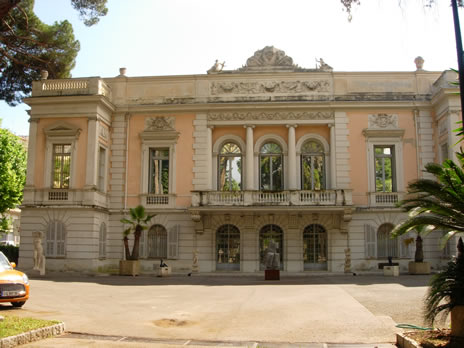
Le Palais de Carnolès est situé à Menton dans les Alpes-maritimes. Le prince Honoré II s’installe à Menton en 1640. Un terrain jouxtant la première résidence princière, est acheté par son descendant le prince Antoine Grimaldi en 1717 aux moines. C’est là que l’architecte Antoine Latour construisit un palais qui devint la résidence d’été des princes de Monaco.
Aujourd’hui, le palais expose au niveau du premier étage de belles pièces datant du 17ème au 19ème siècles. le rez-de-chaussée est réservé pour des expositions temporaires organisées par la ville de Menton. Le parc abrite quant à lui la principale collection d’agrumes de France avec 400 variétés. (Merci à Versaillaise pour les photos)
Palais de Carnolès - Musée des Beaux-Arts de Menton - 3, avenue de la Madone - 06506 Menton - France

Friday, July 16, 2010

Grimaldis Gather for Gala

HSH Princess Stephanie of Monaco welcomed her brother Prince Albert II and future sister-in-law Charlene Wittstock to the annual gala dinner for her foundation Fight AIDS Monaco today at the Monte Carlo Sporting Club. The annual event is held to raise money for the most prominent charity of Princess Stephanie who has devoted much of her life to combating the spread of AIDS and comforting those afflicted with the disease. Recently she has been making frequent radio broadcasts related to the foundation and opened a retreat house in France for those suffering from AIDS. She has stressed the need for respect for all human life as well as using "safe sex" methods. This puts the princess somewhat at odds with the Catholic Church, which is not only Stephanie's church but the official state church of Monaco, which maintains that abstinence before marriage and fidelity after marriage is the only "safe sex". Princess Stephanie, for those who look past the headlines, has long been known for being a very warm-hearted person and a very popular member of the Grimaldi family with the native Monegasque population and her concern for AIDS victims demonstrates this. The Princess herself attributed her attitude to the influence of her parents. As Princess Stephanie said, "Mom was generous and open to others, and this is how we have behaved. Dad did nothing but repeat to me: ‘The fact that you are born in this palace does not make you any better or more important’."

MM Video: The Prince's Soldiers

Related Posts Plugin for WordPress, Blogger...